
The Dust Devil
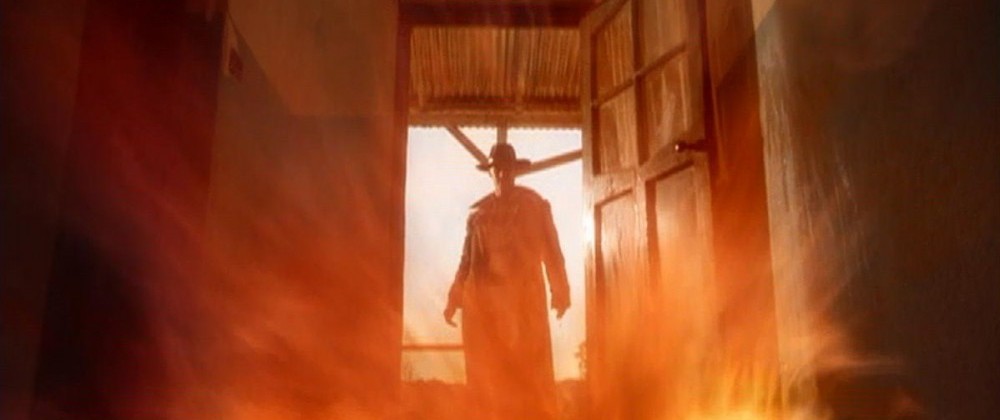
The inimitable Richard Stanley’s films thus far include the cyper-punk cult science- fiction film Hardware (1990), the poetic experimental documentary on the Russian invasion of Afghanistan, Voices of the Moon (1991) and the oneiric horror film Dust Devil (1993). Most recently, Stanley wrote the script for the remake of The Island of Dr. Moreau and was slated to be its director, only to be dumped after 4 shooting days and replaced by John Frankenheimer. The personality conflicts and philosophical differences between Stanley and his co-workers, most notably star Val Kilmer, have already been well documented and thus consciously avoided in this interview. Suffice to say that Stanley’s great admiration and respect for the original H.G. Wells novel was not shared by all. For example, Stanley’s script spared no detail with regards Dr. Moreau’s infamous “House of Pain.” The producers thought Stanley’s vision was too grimly horrific and asked for the “House of Pain” to be tamed. In a phrase which exemplifies Stanley’s wonderful and wacky sense of humor, he replied, “It’s a House of Pain not a House of Discomfort!”
Stanley was in Montreal to present the North American premiere of his final cut version of Dust Devil, which runs some 20 minutes longer than the American Miramax cut. Originally Stanley was to stay for one week, but he was having such a great time that he extended his stay for a second week –much to the pleasure of the many cinephiles who grew to love Stanley’s company. I can’t think of any other “star” (if that label can even be applied to Stanley) who accepted all on-comers, fans, and groupies with such warmth, patience, humor and good naturedness. The following interview was conducted on July 21st, 1997.
Offscreen: How did you get interested in the horror genre?
Stanley: Well I suppose there’s two answers to that. There is the strictly generic answer, that my father was the son of someone who was a close friend of Edgar Wallace, the crime writer, and as a result he had a huge obsession with King Kong. Subsequently King Kong was the first film I ever saw, and my father would repetitively project King Kong when I was very young. So my father’s obsessive love of Edgar Wallace and King Kong probably rubbed off by communicating to me that somehow this was important. Then when I was four years old I saw The Horror of Dracula and Taste the Blood of Dracula at the drive-in theatre. I became a big Christopher Lee fan and being four years old I misunderstood Dracula and cried when he died at the end of the movie…and I cried at the end of King Kong, still do, when Kong falls from the empire state building. This is what people don’t understand about kids and horror movies. Ninety percent of the time kids are unlikely to get scared by Dracula or King Kong but are more likely to identify with the monster and basically turn it the other way; which is what I did and why creepy kids make monster models kits of the creature from the black lagoon or Dracula or Frankenstein’s monster. Kids aren’t essentially frightened by it. I think we sympathize with them because when your a kid you’re socially maladjusted. You have no real place to fit in the world and there’s this fat symbol like King Kong storming through the streets unable to deal with life, hounded by everything, and you can actually sympathize with King Kong. Or Frankenstein’s monster, something which has been newly born and is inarticulate and clumsy.
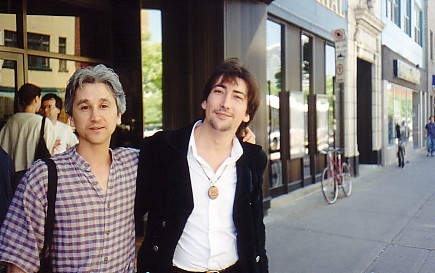
Author with Stanley outside Imperial Theatre (photo source, Donato Totaro)
Offscreen: That’s interesting because all of the classic movie monsters right up until the thirties, the wolfman, the mummy, King Kong, Dracula, Mr. Hyde, all these monsters were sympathetic.
Richard: Yes, essentially tragic heroes.
Offscreen: And then at some point, the sixties onwards, cynicism kicked in.
Richard: Yes it changed quite a bit, yet that element still persists, of sympathizing with the creature.
Offscreen: There’s a bit of that in your Dust Devil character.
Richard: Yes there’s one difference again between my cut and the Miramax cut, and that is you don’t get to see him cry in the Miramax cut.
Offscreen: That’s the bed scene between Wendy and the devil.
Richard: Yes, they removed his one weak moment where he gets to cry. It’s cut from the American print.
Offscreen: I wanted to ask you about that scene because it seems to pull together a lot of different things. For one you have the circular boom shot that comes down from the ceiling toward them…
Richard: Yes, that’s another attempt to make a spiral motion in the movie.
Offscreen: And the shot right before it is of the concentric primitive wall painting.
Richard: Yes, the film is constantly trying to spiral, which is why the plot construction is so messy. It has this silly spiraling plot construction where all the plot threads, and characters are looping around each other but don’t really get to meet until the tail end of the movie. There are three or four different running strings of events going around each other and actually zeroing in on an ending, and then his head explodes!
Offscreen: But the end has a circularity with Wendy perhaps taking over as the new host body for the dust devil.
Richard: I sort of attempted to construct it as a spiral. It’s not a Hollywood structure at all.
Offscreen: Why the zebra blankets?
Richard: Oh, the zebra was pure African tack, like the radio commercial about some safari. It’s what you’d sort of expect from Africa. The tacky hotel with pictures of rock formations and the zebra skinned bed were just your classic tacky African safari-oriented motel decor. I thought I’d keep it constant as fairly recognizably African or South African.
Offscreen: I love that shot toward the end of the film inside the abandoned building when the camera makes a semi-circular track from Wendy, to a mirror in which we see the Dust Devil reflected outside the window and finally to Ben hiding up against the wall. It reminds me of a similar shot at the end of Deep Red.
Richard: That’s one of my favorite shots in the film. I don’t really know what it means or how it fits into the rest of the film. It came at a time during a halt in the production and I thought, well I’m going to take as much time as necessary to get this complicated shot, and it took a whole day to get it down.
Offscreen: I’ve been thinking a lot lately and I think it relates nicely to your work because of how you tend to mix genres, of this idea of a new genre, the art-horror film. European and American films like The Addiction, Nadja, Dellamorte Dellamore which mix elements of the horror genre with the art film. What do you think about this confluence of art and horror?
Richard: Well, I have a complicated take on that, which is the non-generic, complicated explanation to horror. The easy one is, that my formative influences are King Kong and Dracula, and that’s easy to understand. Then there’s the hard one to understand, which in a nutshell goes like this. For thousands of years true art was considered to be things that dealt with spirit, with God, the devil, the devil’s soul, and the afterlife. Art was something that was sponsored by churches, like the ceiling of the sistine chapel, great art was considered to be religious art. It seems to me that only in the 20th century has this dichotomy developed where essentially we’ve managed to separate religion from art completely, where art now seems to be based more on social realism and social commentary. Where regularly we give out the Turner prize to people who take out plastic casts of the inside of their terrace houses or make comments about their personal space or about society. The great art or fine art recognized by the people who put out the prizes and by the galleries, is nearly always obsessed with society, social conditions and the space we are living in, literally the physical, material space we’re in. The issue of spirit, soul, eternity, is completely missing, in all respects. If you deal in a film with God, the Devil, the afterlife, inevitably you’re in the genre, where films that deal with these subjects end up being films like Jacob’s Ladder, Brainstorm, Flatliner, Ghost, The Exorcist. The moment you start dealing with God, the Devil, the big issues, you end up in the genre, whether you like it or not. So in some bizarre way the horror genre has become the last place where you can really deal with these things. If you’re trying to actually do something which is about those kinds of issues, that is where you end up. Even Tarkovsky ended up in the genre, whether he knew it or not, with Stalker and Solaris which are science fiction. So even Tarkovsky was drifting into the genre simply through his interest in these areas. If you’re trying to deal with those kind of issues there’s almost nowhere else to go because they won’t allow it in a conventional movie. You can’t have a supernatural thing happening in an otherwise ordinary movie without people saying, hey you can’t do that. You can’t all of a sudden have someone move a glass on the table with their mind in an ordinary movie [ed. Richard Stanley is here referring to a scene in Stalker ]. If that happens it’s got to be genre. So therefore in the 20th century for some reason all what I consider to be all the big issues have somehow been sidelined into a ghetto genre. But this is actually 100% in keeping with the underground stream and the way the stuff is meant to survive. Because traditionally, esoterica is meant to survive inside gothic art as a self-censoring secret, as something which survives symbolically, which is available for those who care. So apparently the idea of a mystical tradition or a tradition of dealing with spiritual issues, surviving encoded in a debased ghettoized genre, survives in something the public at large would regard as one step above porno, roughly the same level as comic books. Something which is looked down upon from a dizzy height as compared to the perceived serious movies, the Ghandi ‘s and The English Patient ‘s of the world.
Offscreen: So art and horror inevitably gravitate toward each other.
Richard: Yes, because ultimately, it’s the only way you could deal with God. It’s a funny way if one is actually concerned with it. And I’m very concerned with it because I know I’ll die one day and it is of extreme importance. I also recognize the genre will always be with us because I know that inside of every person there is that same knowledge that everyone knows they are going to die. All of us quietly wonder about it, what it will be like. In the simplest meaning people watch horror because they are frightened of the bad death, and they are interested in knowing what it would be like. When you’re a teenager you want to know about sex and death, so you sneak onto a horror movie. You don’t really know why but you’re inquisitive because these are things you need to know about since they will happen to you.
Offscreen: The horror genre is also very much about transformation, a metaphorical reflection on different stages in one’s life, both physiological, like sexuality, and psychological.
Richard: They speak of truth, which is often unavailable in any other form. One thing I’ve really noticed in life which is increasingly true to me is that one is inevitably confronted with horror in some way. Life messes you up. It kills the people you care about, rapes one’s loved one’s, destroys the things you care about, anything you love gets ultimately killed. If you have a pet it gets killed, or it dies horribly. At the same time the only sort of relief you get is a relentless constant stream of American products which are constantly telling us it will be fine, it’s all good, we’ll all live forever, we’ll all be happy, it will all work out. Beyond a certain level this can’t speak to us in the same way that a horror movie will speak to us, which is, yes things can be terrible, but maybe within that there is something which is not totally hopeless.
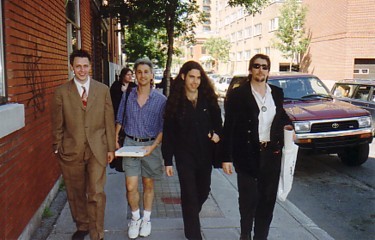
Prowling the streets of Montreal ‘Reservoir Dogs’ style, L-R, James Gunn, Author (holding pizza box!), Mitch Davis, Richard Stanley (photo source, Donato Totaro)
Prowling the streets of Montreal ‘Reservoir Dogs’ style, L-R, James Gunn, Author (holding pizza box!), Mitch Davis, Richard Stanley
Offscreen: Along that line, there is the scene in Dust Devil where Wendy first picks up the devil. They are driving along and he asks her whether she believes in God, the devil, the spirit, the soul, and she says no…
Richard: Like in Peter Pan, she is called Wendy on purpose… there’s a lot of Peter Pan jokes in that movie!
Offscreen: She specifically says I don’t believe in magic, and then at that point we cut to the devil outside the car hitchhiking along the road, yet she still doesn’t believe what she just saw, doesn’t believe her eyes, the physical world. Is that a comment on non-believers who even if they see magic don’t believe it?
Richard: Yes I guess so, but I’m not really sure what that scene means. I put that scene in the movie because I felt somebody in some movie had to do that scene, because that scene’s been happening again and again and again in the 20th century. The disappearing hitchhiker story has been reported million’s of times, so I felt someday someone in a movie has to actually do that scene where you’re talking with the hitchhiker and you look around and he’s disappeared from the passenger seat. I have no idea what that means, or why it happens to people but it does seem to be a surprisingly common experience. People all over the world seem to have vanishing hitchhiker situations or a bunch of hitchhiker stories. We’ve seen it happen in Africa, in Australia, in Britain, in America, all over the place people constantly report disappearing hitchhikers. Usually they’ll say something ominous or make out prophecies. It’s not my story, neither do I know what it entirely means or why it is that we at least feel compelled to report the incidents, regardless of whether they actually happened or not. I wanted to include it in the movie to root it to some actual pop mythology. Just as the walking man, the man with no name is not my creation but is an attempt to put a recognizable pop mythology icon in there and explore that a little.
Offscreen: It also can be very mystical.
Richard: Yes, I by no means take credit for him. I just wanted to set the record straight because Eastwood is doing a poor job lately by misinterpreting the man with no name by making him more human or more on the side of the angels than he was. He seems to have drifted apart from the spaghetti westerns. As he’s gets older he wants to be more human and has tried to make the walking man a nicer person, and in the end denying the more frightening aspects of that character. I thought the television version of The Stand was appalling, awful. Basically it was a recent attempt to deal with the walking man with no name archetype, and I felt it was poor on that level.
Offscreen: And it’s treatment of morality, good and evil, was so trite and simplistic.
Richard: I was so disappointed by their devil. I thought that’s just not the walking man. In a funny way, Val Kilmer would play the walking man very well, yet it doesn’t need to be sexy, it can’t be Jamie Sheridan. I just figured at the time when I made Dust Devil it was like a Tarot card in which the traveling man with his worn down boot heels somewhere between towns, walking the miles somewhere out there had to be defined. I felt he deserved a screen incarnation or to be somehow crystallized into something. I wanted to try and capture him and define him a little. But I’m never sure who he is or what he means because I didn’t invent him. I myself express a certain amount confusion over what his precise symbolic value is.
Offscreen: It seems to borrow a lot from the Orpheus myth. He comes from the other side of the mirror to collect the soul’s of people who are dying and bring them back.
Richard: A lot like that, and it also works as a kind of demon lover from an Id movie, because we are never sure whether he’s there or not, like when he pops in and out of the car seat talking to her when she’s run away from her husband. Imagine that you’ve just run out on your husband and your diving across the desert and all of a sudden Clint Eastwood materializes in your passenger seat and he’s asking you how your doing. Then he’s gone and later he pops up in your motel room, then he’s gone again. I keep wondering if he was ever really there. I think the film would double bill quite well with Andrzej Zulawski’s Possession, which is another marital breakup movie where the angst is manifested into a non-existent tentacled creature, which is sort of a coalescence of everyone’s pain. I thought that in a way he’s almost an invisible character who coalescences out of all the collective pain of the movie.
Offscreen: The Brood is another one of those type of marital breakup angst films…Cronenberg made it after a messy breakup and referred to it as his Kramer vs. Kramer.
Richard: That was the sense of things that I had, like a topic extrusion of the whole thing. Like you said earlier, he comes from the other side of the mirror and as he says at one point, “I come from you” which is fairly specific.
Offscreen: Yes I love the dialogue like that which runs throughout the film.
Richard: It’s a little portentous and at times I’m aware of how young I was when I made it…on the earnest kind of adolescent level at times.
Offscreen: I especially love the line where the devil says, “There is no good or evil, only spirit and matter.” Coming at a time when most screen monsters grumbled or spouted comical one-liners, it was quite refreshing.
Richard: I’m glad I put that line in. A lot of the time he’s speaking pure gnosticism. There are whole junks of it were’s he just coming out with pure gnostic heresy. I don’t think it was even intentional, but it strikes me now when I watch the movie and see how he goes on about good and evil, spirit and matter, light and dark. It basically dispenses with conventional morality and tries to replace it with a totally different idea of movement toward the spirit or away from the spirit. The friction between matter and spirit, rather than good or evil is definitely outlining something similar to gnostic thought, although I wasn’t that aware of gnosticism when I made the movie. It was only afterwards that I thought, wow, I sort of understand where he was coming from.
Offscreen: Relating to that duality between spirit and matter, as I said before, the film plays around with circular imagery a lot, thematically and visually. Like the moment where Wendy wants to get to the edge, the end and drives to the precipice. To me that represents a linear conception of the world, going straight and ending somewhere. That’s her moment, so it’s as if she represents the white man and the linear, Christian conception of temporality or the afterlife, as opposed to the circular conception’s of time associated with many Eastern, native or aboriginal cultures. Is the South African conception of time similar to that of the aboriginal dream time?
Richard: Yes, quite similar, but let’s not be too specific about the Bushman and the way they are in the movie because I wanted to make the mythology a little bit more universal. I tried to imply this by having the resident keeper of wisdom in the movie, the witch doctor/drive-in projectionist character as a little untrustworthy. As Ben says, you’ve been watching too many drive-in movies. Maybe he is coming from an ancient tradition but it’s also because he’s wearing a walkman and working at a drive-in, that the witch doctor’s quite likely to be very sophisticated and is probably drawing on all kinds of different things. For example we know there’s a vampire film playing…
Offscreen: Yes, and he does function somewhat like a Van Helsing character.
Richard: Yes, that’s right, so I have a certain amount of mistrust in the witch doctor because he’s obviously not in the stone age, he’s living in the 20th century. And the killer of course is not from Africa, he’s from elsewhere. I tried to imply this somewhat by having some ruins in the brief shots of the coins he’s left on the table that are bits and pieces from different cultures to give the sense that the guy’s been around all over the place. I know he would be right at home. I always thought, where would I be if I were the devil? I’d be in Beirut, in Yugoslavia, all the places where the walking man would come to call. Not just Namibia, but no doubt wherever things like that were happening and no one would notice him. This way rather than being specific about the Bushman, one could actually open it up to a lot of people. I do believe that at their source, most cultures are very similar and that we all have similar conceits. Like the center of the universe, the one tree, and the Hopi Indian idea of the ancestral point of emergence and the journey down into the underworld…this ceaseless spiraling into infinity.
Offscreen: How about dreams, how important are they to you as a source of artistic inspiration?
Richard: Very important…I don’t have enough of them anymore. I do dream, but I don’t have the right kind of dreams as much as I want to have these days. It has to do with living amongst humans too much. As a result I tend to get dreams made up of frantic bits of social and relationship problems, work things which get recycled into one’s sleep. My dreams have become too mundane lately from living in London and in the West [huge laugh on my part]…really that’s what it is. I’m sure if I was out in the mountains or the woods for a while I would start to have stronger dreams again, but certainly I had very bad dreams about the walking man for years and years.
Offscreen: So you got some of your movie imagery from your dreams?
Richard: Yes, funny enough even more so in Hardware. The first three or four minutes of Hardware is based on my dreams, one of the same cycle of dreams. I dreamt for a long time about the walking man, and in that particular dream he’s walking around in hat and coat in the wasteland, searching for something, but I don’t know what. Then right in the middle of the dream he starts digging into the sand and suddenly digs up this metal skull, with camera lens eyes. I don’t know what happened after that, but the first few minutes of Hardware were definitely a dream. And there were many other dreams from that same period about the same guy in the hat and coat and that lapsed over into Dust Devil. I think he was a symbol of some sort of fear, of some sort of encroaching anarchy, chaos to an extent. A favorite dream moment I never ended up using was one where many things had happened, but in essence my house is on fire. All my things have burned up and I’m blown out through a window and lay dying in the garden, peppered with shrapnel. I look up and the walking man is dancing on the roof of my burning house, yelling “I’m dancing on the roof and there’s nothing you can do about it!”
Offscreen: For the opening of Hardware, had you seen or were you at all influenced by The State of Things by Wim Wenders?
Richard: Yes, I love that movie! I love Paris, Texas more over the years. I’ve been increasingly discovering I have insomnia and sort of feeling the need to stay up all night, singing Mexican songs and polishing shoes.
Offscreen: Wings of Desire is a nice one as well.
Richard: Yes, it’s his last good one. I just think something terrible happened to him after that, I don’t understand it. Until the End of the World and all the other one’s seem totally awful, I hated it, and Far Away So Close as well. Everything Wenders says these days I don’t understand, when he talks in interviews he seems to be coming from another planet. He even renounced his early movies. I don’t know what happened. He says he wouldn’t make them like that anymore and finds them too slow to watch these days. I used to admire him like mad, now he’s gone so wrong these days it almost makes me want to reexamine his early films and not like that so much.
Offscreen: It’s almost as if you have to think of them as two different directors, Wim Wenders 1 and Wim Wenders 2.
Richard: Yes, it’s terrifying when that happens to people. I’d hate it to happen to me, because you obviously don’t notice when it happens, when you stop making good work and go off the boil. It’s happened to Dario [Argento] and I love Dario, but it’s happened to him for sure, and he won’t come back either.
Offscreen: You don’t think so…you’re down on Stendhal Syndrome all the way?
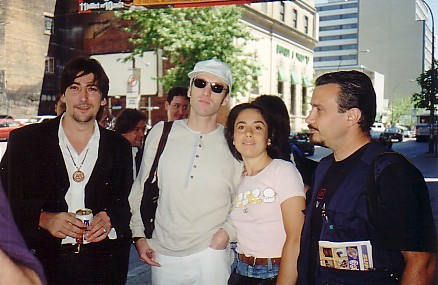
Richard Stanley with Mariano Baino, Patrizia, & Sergio Stivaletti (photo source, Donato Totaro)
Richard: Yep, I’m afraid so, it’s awful, so is Trauma. Very unfortunate. It shows little sign of any hope really.
Offscreen: All this reminds me somewhat of Lev Tolstoi, and his great tranformation in art after he converted to Christianity, wrote What is Art? and denounced all his earlier great works in favor of his later works which where lesser works of art but contained more direct moral messages. I think someone like Andrei Tarkovsky got it right with his balance between great art and morality.
Richard: I think Tarkovsky was also losing it toward the end, I hate to say that, but I don’t like The Sacrifice much, you know, it’s his least work. It’s a good film by anyone else’s standards, but it’s a strange progression from Nostalghia because in Nostalghia the character burns himself and in the next movie he burns his house, and it struck me as a kind of anti-climax. If he would have shot them in the opposite order it might have been different, but it struck me that by the time he got to The Sacrifice he wasn’t saying anything new and at the same time saying it with less power than he did before, which was a bad sign. Even Nostalghia I didn’t like quite as much as Stalker and Mirror, which are amazing works. But, of course, on days when I don’t think Stalker is the greatest movie ever, it’s Mirror. I wish Tarkovsky had made Bulgakov’s The Master and Margarita, I’d love to have seen what he would have made out of a devil movie. But I was disappointed when I saw The Sacrifice
Offscreen: I still like it very much
Richard: I still like it, by anyone else’s standards it’s great. It’s the same as what’s happened to Werner Herzog, he’s also completely lost it, in that Scream of Stone and Cobra Verde, are very disappointing compared to the earlier works. But at the same time, Cobra Verde by any other filmmaker is still a good movie. One can’t complain too much. Dario is sort of the same, I mean Stendhal Syndrome while bad is ultimately better than the average American horror movie. Which is being extra hard on these people but it’s because they’re really capable, and it sort of is sad to see them at anything less than full power.
Offscreen: We’re doing this for their own good!
Richard: It is rather. Dario I always want to somehow jolt him or blast him, or write some material for him, or do something, I can’t believe he’s lost it for good, it’s too depressing, and Opera ‘s such a short time ago, it seems like a very rapid decline.
Offscreen: I was thinking of Tarkovsky, and relating him to your work, I could see quite a bit, snippets of him, especially in Dust Devil , like in the scene where the devil visits the boy at the military shooting range, which is right out of Mirror.
Richard: It’s interesting that you should say that.
Offscreen: I may be the only person who noticed that!
Richard: Because of course it’s also one of the scene’s in the movie which is most true to life for me, but obviously Mirror touches me deeply, possibly Mirror touches me deeply because there are elements in it that are very similar to bits of life which one recognizes, and that scene is very much based on an incident which happened to me when I was that boy’s age.
Offscreen: There are many other instances of Tarkovsky emerging in your films, like the naming of the “Zone” in Hardware, the scene of the burning house and encircling car, and the incongruous telephone ringing in the abandoned house in Dust Devil . I was intrigued when I read in your Dust Devil diaries that you kept a copy of Tarkovsky’s book Sculpting in Time on the set with you to consult in times of duress. In what way do you find inspiration from Tarkovsky?
Richard: Well, Andrei really is for me like a patron saint, a guiding light in the midst of chaos. When everyone else is running around losing their heads, freaking out about the pressures of time, saint Andrei speaks to me in a still voice and gives me an idea of what really matters, of what it was that we really got involved in this medium for in the first place. His films demonstrate the potential for this medium to reach people, to touch people’s souls and hearts and to somehow communicate something of the essence of what it is like to try and be alive in this world. I know this is extremely woolly, and Tarkovsky himself would have had a very hard time explaining his own work, but a great number of things the man did and labored towards are inspirational. In some respects even the essential ambiguity of his work and the way he labors toward the situation of maximum ambiguity as opposed to the way an American would work and the way people insist that everything should be nailed down to just one meaning and one definition.
Offscreen: Nice. I guess I could use this idea of maximum ambiguity as a lead in to the final shot of Dust Devil, which you’ve jokingly referred to as your Tiannamen Square shot. Could you talk a bit about this final ambiguous, almost mythical image?
Richard: As scripted at the end of the film, the main character having survived various tribulations in the plot is meant to find a way out of the desert to the nearest road and be rescued. But once we came to shoot the scene of course this seemed rather simplistic; and as we had at our disposal a convoy of armoured cars lent to us by the Namibian defense force I started to imagine the traffic on the road as representing the future. The road itself seemed to represent a linear time line moving through the spiraling chaos of the film. The plot structure is very much a spiral and the road is kind of a straight line right through that, but nonetheless, I had chosen in the end to portray the vehicles in the road in such a threatening manner that they scarcely seemed to be rescuing her, just as the red light up ahead scarcely promises salvation but promises something quite frightening further down the line. At the same time we’re not even sure anymore whether she’s the heroine or whether she’s the devil incarnate. I’m not sure whether she’s going to be rescued by them or whether she’s going to kill them, or whether they are going to kill her. I went to some lengths to cut out of the scene before the vehicles even started to slow down because I didn’t want to resolve it one way or another. I wanted to leave it hanging on the edge as much as possible so the audience could make up their own mind as to whether she was a heroine or bad guy, whether she was being rescued or going to be killed, or what was going to happen next. I wanted to leave it more or less so anyone could take home from the movie whatever it was they wanted to feel. Which is something that saint Andrei was very, very good at, in that every single time that I see Mirror it seems to mean something entirely different to me, full of varying different messages and no one of them seems to be the actual explanation. I think in that way I attempted to produce a situation of maximum ambiguity. I mean for me ultimately, magic is something that can’t be described. If I had in my hand an object which was indescribable, which could be any object, then presumably it could appear to be all things to all people. One person would think I were holding a cigarette, someone else would think it was a knife, someone else might think it’s a flower; but if someone had something which could be infinitely ambiguous, then you’d have something which is truly magic, which every single person could interpret in their own way, to have some personal meaning which was unique to them. I’m getting lost here, so I’ll stop!


