Search This Blog

Showing posts with label Interview. Show all posts

Wednesday, 19 August 2026

The Thin Red Line - Interview with Hans Zimmer


    The Inside Film Interview with Hans Zimmer, Music Composer

    This interview originally appeared in Inside Film on an unlisted date. Interview by Simon Goodman. Copyright of A & R Publishing, Limited.

    No. 5 Film Composer

    Composing the score for The Thin Red LIne was the hardest commission Hans Zimmer has ever accepted. And this is a man with one of the most prestigious portfoliors in the industry including As Good As It Gets, Rain Man, The Last Emperor, The Prince of Egypt and The Rock.

    Where did you train?

    I had two weeks of piano lessons. I was Stanley Myers' assistant--he wrote the music for The Deer Hunter. I was also in the Buggles. Remember Video Killed the Radio Star? We ruined a whole generation! I was doing commercials in London for Air-Edel. THey had a load of film composers and that's how I met him.

    What was your first gig and how did you get it?

    My Beautiful Laundrette. They let anybody do movies back then. Stanley and I did it together. After that I did A World Apart. That was my big break. Barry Levinson's wife liked the music and went out to buy the CD, and Barry hired me for Rain ManBlack Rain and Thelma and Louise for director Ridley Scott.

    What is the strangest film that you've had to score?

    True Romance was the strangest. We had money for nine musicians and so to spite the budget I hired the most useless, incongruous bunch of guys I could find. The diversity gave us a great result!

    And the hardest?

    Thin Red Line was the hardest. Terrence Malick wanted me to write the music first. Usually you compose to a rough cut. I threw all my previous knowledge out the window and started again. I needed to provide a structure for him to build the film on. Th one thing Terry gave me was the ability to be a better composer. I wrote for nine months without a day off. It was incredible pressure in the cutting room.

    Where's the best place to learn the craft these days?

    I thought the film music course at UCLA wasn't great so I put together a one-day seminar and taught there. The best training, though, is to just do it, not study it. You learn through failure. Commericals are a good place to start. It's about learning the aesthetics. You could also try becoming someone's apprentice. In LA, I have a whole studio of young composers learning off me all the time, in the same way that I learn from stanley all those years back.

    What about someone who want to get into the business?

    Ask yourself these questions. How sure am I of my talent? How stubborn and resilient am I? You need to stick to your guns when the going is tough. Also see yourself as a film maker, not a composer, because you are writing, but in a different language.

The Thin Red Line - Interview with Dash Mihok


    The Inside Film Interview with Dash Mihok

    This interview originally appeared in Inside Film on an unlisted date. Interview by Steve Goldman. Copyright of A & R Publishing, Limited.

    Friendly Fire (Part I)

    You must be pleased to be part of such an epic film.

    And to remain on screen, absolutely. I mean, there were a lot of other guys who were down there for months and they appeared for just 30 seconds. So at the very least I'm thankful for that. But even now I can say I loved it. I just thought it was so different from any other film I've ever seen. It's so much more about the balance of life, our connections and non-connections with God, our fear and non-fear of physical death and its meaning. It is about the struggle of each particular man in his own inner thoughts, and fears, and yet it's also the story of the whol group.

    Did the film make you think differently about war?

    Well, I wasn't a fan of war from the onset, I have to say. But in making a film like this you can get as close as you possibly can to that kind of experience without being shot at. I feel that when you're acting and you raise yourself to that level of adrenaline, it feels as if you're almost there. It has definitely left its mark on me.

    What attracted you to the project?

    All the obvious reasons--a great script, a great part, a great director. To be honest, I would have been excited to go and just work as a production assistant.

    Was anyone injured during the filming?

    To a limited extent. People got hurt here and there. There's one shot that Terry had to keep in the film because Ben Chaplin cut his face in it. Things like that. People tripping and falling. People following a little too close here and there. A lot of extras. A lot of actors. A lot of weaponry. A lot of tough terrain. For me, though, it was a simple equation. I was beaten to a pulp every night and my shins were as black as your hair--every night.

    You have a number of scenes with Sean Penn, whose reputation precedes him. What was it like working with him?

    Sean is Sean. He's so Sean. You know, he's funny and he's dry. He can be cynical and brutal and hysterical. He's all those things, he can turn on a dime and be mean, and then he's the sweetest guy in the world. But if anyone, it was Nick Nolte who dominated the set. Then again, it might have been an extension of his role as the Colonel. Of course, everyone at the end of the day took their marching orders from Terrence Malick.

    How does The Thin Red Line compare to Saving Private Ryan?

    I didn't think that Saving Private Ryan had a great script. I mean, I kind of think the script sucked basically. I think it was a great film and a great Spielberg movie, but this script blew Private Ryan out of the box. And by the way, I read for Matt Damon's part--Private Ryan--which I didn't get.

The Thin red Line - Interview with Elias Koteas


    The Inside Film Interview with Elias Koteas

    This interview originally appeared in Inside Film on an unlisted date. Interview by Steve Goldman. Copyright of A & R Publishing, Limited.

    Friendly Fire (Part II)

    How did you get cast in the film?

    The usual way. I was sent the script by my agent about a month or so before filming started. We set up an appointment. I auditioned. They put me on tape and sent it off to Terrence Malick in Australia and that was it. It happened real fast. Just the same way I'm sure that real soldiers are recruited. You get the news and boom! You're on a plane and suddenly you're off overseas with all the fear and anxiety of fulfilling your mission and the fear and anxiety that you might not be able to cut the mustard.

    Were you up against any major names?

    I don't know. It was tough for him to cast the whole film, though. I heard that it took a while. So I felt that weight as well, that sense of rsponsibility in taking on the part, which was paralled in the character's sense of responsibility towards his men. Each time you go into a job, each journey is different. Sometimes you feel like you're nailing it, other times you feel like you've never acted before. This time it was more of the latter. Couple that with having limited reheasal time and that puts on a lot of pressure. As an actor you try to use it.

    What is the relationship between this film and Steven Spielberg's Saving Private Ryan?

    America learned a lot about warfare during Guadalcanal, as depicted in this film. The troops were green and inexperienced. Hence the major connection with Private Ryan is that what we learned in warfare in that vicious South Pacific battle we took to D-Day--Oddly enough, I was also cast for this film on the anniversay of D-Day.

    What did you know about Terrence Malick?

    Only his reputation. It was only when I got home that I watched his previous films. I was aware of Days of Heaven and Badlands, but I hadn't seen them. But I learned a lot, obviously, by working with him. Terry has an amazing improvisational quality. When he discovered my Greek background, for example, he incorporated it into the character.

    How close did it feel to a real battle?

    For those five months, it was my war. You have to go through that process. For better or for worse, my life paralleled some of those anxieties. And I could only use that in terms of myself and my craft. If I don't get this job right as an actor, will I have a future? The same for Captain Staros. If he doesn't fulfill his mission, will he have a future as a soldier?

    What was day-to-day life like on the set?

    Obviously, we didn't have trailers, we had camps. And then we would either hike along the trails or be driven to the set, or "the front" as I would call it. It was very similar to Chapter Four of All Quiet on the Western Front. That's the parallel. And I don't mean disrepsect towards the men who endured it. Whatever I understand, it is in my own minuscule way, compared with what any soldier goes through.

    It's quite a jump from your Ninja Turtle films. I assume Malick didn't base his casting decision on those performances.

    No. He didn't se anything I've done. Didn't want to. He felt it would distract him from assessing me. He wanted to see me as me and then try to capture that. And I respected that. I also didn't want to see his other movies and be intimidated. So we both started on a level playing field.

    Has being a part of this film altered you?

    I knew going in I would come out altered. That was part of the attraction. No one ever changes on a casual whim. You have to go in kicking and screaming to come out the other end in some positive way with a different appreciation for life. After a while I felt such a connection to the insanity of the moment that I was addicted to it. Anything other than that wasn't enough. We were scared, and that's why the film is authentic.

The Thin Red Line - Interview With Ben Chaplin


    Inside Film Interview With Ben Chaplin

    This interview originally appeared in Inside Film on a date I can't find anywhere contained in it. Interview by Simon Goodman. Copyright of A&R Publishing, Limited.

    Game Over

    Ben Chaplin's apprenticeship as the latest export of Cool Britannia is over. Simon Goodman spoke to him about how he manages to keep sane in a world full of poodle parlors, plastic surgeons and directors who send you off to boot camp.

    Ben Chaplin moved to Hollywood by default. It wasn't work that sent him there. It wasn't ambition to become the greatest British living legend. He wasn't hankering to be to be the next boy from over here who's doing rather well over there.

    "It wasn't really a conscious move. I was chasing romance more than work. Then I met a couple of people there who saw me in a play in London and then I got an agent."

    That led to his film debut in The Truth About Cats and Dogs in which he starred opposite Uma Thurman. Chaplin then took the leading role opposite Jennifer Jason Leigh in Agnieszka Holland's version of Henry James' novel Washington Square. His next big feature film project is Lost Souls.

    Not bad for a lad who made his name on British TV as Matt, the surfing skunk pussy with agoraphobic tendencies in BBC sit-com Game On. Despite the fact that Ben has spent "more time out there than I have done over here in the past four years" and much to the disapointment of the cynics and the wannabes, he will never lose touch with his roots. Or dye them for that matter because he is not an advocate of Beverly Hills chic.

    "It's an interesting phenomenan. Some people think that just because I am working in Hollywood I have rejected England. That's so English. I'd never pretend to be American or adopt any aspect of the accent." Perhaps it is Chaplin's nostalgia for his home turf that influenced Terence Malick's decision to cast him in the role of Pvt. Bell.

    "You always make it better than it is when you're away from your loved ones. Terry always had this thing about Bell's wife--that my imaginings, my memories of the relationship were rose-tinted. The memories needed to be as good as that to keep Bell going."

    Chaplin acknowledges that, like the other actors in The Thin Red Line, he was a receptacle for Terence Malick's vision. "My journey is Terry's: he chose the journey for all the characters. We all represented something different. My character was the embodiment of love. I myself had this whole other journey in the film so I never felt more powerful as an actor as I did working on that film. Terry was a big enabler. However, I never felt more powerless as well. Terry's a visionary. You trust it because you are there for him. All of us were there to serve him."

    Chaplin's personal journey reflects one that most of the cast seem to travel through while filming.

    "The whole film was a massive life experience. I am now Ben Chaplin plus that film. It was intense." The intensity began with a nine-day World War II style boot camp hosted by a couple of Vietnam vets. "You had to have your rife with you the whole time and if you didn't you were seriously punished. Not just you but the entire platoon were sent on a two mile run in the tropics. I can't tell you how hot it was."

    Did anyone throw a wobbly?

    "No, but we all wanted to. We thought that it was going to make us all sick before filming. And we were! But during the process we all realised how absolutely necessary it was".

    What followed was an exhausting schedule that lasted five months. Though Chaplin is adamant that it wasn't on Apocalypse Now levels.

    "There were a few times when I went stir crazy. One time I took a production car without permission and just drove it back to the hotel. That is sinful and I could have been fired for it. No one found out. Once I got back to the town I rang up and told them where I was. I was going nuts.

    "When you partied you partied very hard and not in a particularly sensitive way. it was very male. You felt it happening to yourself. It wasn't anything you could control. There was a lot of drinking. We played pool. I was actually quite good. They were playing American rules, you've got Australian rules, then there's Queensland rules which are different to the New South Wales rules. We were close to few punch-ups around the table a lot of the time."

    Chaplin, however, is very aware that to compare his five months in the jungle with that of a real life experience smacks of the kind of luvvie bravado that gives his profession a bad name. "It seems disrespectful to to compare the bond that was created between all the actors with the bond between the soldiers who died in the actual conflict. On my level it was the most intense bonding I have ever gone through, There's a tenderness there which really comes across in the film. An experience like that stays with you forever."

The Thin red Line - Interview with Jim Caviezel


    The London Interview with Jim Caviezel

    This interview originally appeared in This Is London on February 23, 1999. Interview by Steven Goldman. Copyright of Associated Newspapers, Limited.

    Leading The Thin Red Line

    If Jim Caviezel carries the translucent shroud of shell-shock about him, it's with good cause. The 30-year-old actor is, after all, a survivor of Terrence Malick's Second World War epic, The Thin Red Line - easily one of the most anticipated and perplexing films of the year. Still, it's hard to say if Caviezel's aw'-shucks farm-boy bewilderment is due to the sudden spotlight which surrounds his de facto stardom or the fact that his performance somehow managed to survive one of the messiest cutting-room floors in recent memory.

    "My whole thing was to do the best I could," says the man himself, a virtual unknown outside casting circles until hand-picked by Malick for the central role of Private Witt - an AWOL grunt who returns to his unit for the battle of Guadalcanal. "There were many voices who said, 'We could get Brad Pitt. We could get Matthew McConaughey. We could get Johnny Depp ... Caviezel - we can't even pronounce the name'. Well, I told Mr Malick, 'You ask them if, when they first saw it, they could pronounce the name Schwarzenegger - I certainly bet they were able to do it after a few million dollars'."

    In short order, Hollywood has learned to pronounce the name (it's of Swiss origin and sadly rhymes with "weasel"). All it took was rave reviews and a million-dollar-plus opening in the US, despite a release initially limited to a scant seven theatres. And so, all of a sudden, Hollywood has come to court an actor often dismissed in the past.

    Dressed in a rag-wool sweater and sporting the requisite blend of humility and braggadocio, Caviezel certainly looks as if he's the new male lead. The fact that he is, in The Thin Red Line at least, is down to pure luck. Initially 20th Century Fox decided to build an early publicity campaign around newcomer Adrien Brody, who was central to the original screenplay, only to discover that his performance was largely excised from the final cut. (Among the other amputees from the million feet of footage: Gary Oldman, Bill Pullman, Lukas Haas and a voiceover narration by Billy Thornton; stars John Travolta and George Clooney survive, but enjoy less than six minutes of screen time combined.)

    "I was so focused on the job at hand that I never thought beyond filming," says Caviezel, who spent 127 days on a shoot which moved from Daintree Rainforest in northern Australia to the Solomon Islands. "Every day I would say, 'Today is the last day of the rest of my life ... this hour, this moment, this scene right here'. So I never thought I'd be sitting here in front of you. Never conceived it ... I had simply promised the man who had given me the opportunity that I would give it all I had. And I knew what a responsibility it was."

    A Catholic schoolboy from rural Mount Vernon in Washington State, Caviezel describes himself as a "shy kid" who developed a taste for mimicry at an early age and, soon after, the stage. "I would do Eddie Murphy, just about anyone to get a laugh. But then when I started doing plays in school, things began to change. All the nuns and teachers would come up afterwards and tell me I just had to go into acting. Of course there were two things I didn't want to be back then, namely an actor or a priest. I mean, if I had my choice, I would have been a basketball player."

    Caviezel, nevertheless, soon made his break from hoops to acting with a bit part as an Italian ticket agent in Gus Van Sant's My Own Private Idaho - securing the role only after fooling local casting agents into believing he was a recent Italian immigrant. With a Screen Actors' Guild card in hand, he moved to California with his wife Kerri (the couple now divide their time between LA and Mount Vernon), landing minor roles in lacklustre films like Diggstown, Wyatt Earp and Matt Le Blanc's monkey movie, Ed. To put it bluntly, Caviezel found himself going nowhere fast. "I was looking ahead through my life, where I wanted to be and what I wanted to do. It was around that time I started thinking about going back to school to become a chiropractor, like my father. Fortunately it was around that time that I also got the call from Terrence Malick.

    "I grabbed the phone and tears started coming out of my eyes," says Caviezel when asked about the summons from the maverick director of Badlands and Days of Heaven. "I told him that whatever he needed me to do, I had the confidence to do it. That I'd be there for him."

    And in the end, it was Malick - returning with his first movie in 20 years - who remained faithful to Caviezel's performance. "Towards the end of filming, I'd get calls from my agent about new projects casting out of [20th Century] Fox. But they needed to see this film first and I didn't know who was going to be cut out. I could have been cut out, for all I knew ... I just happened to be fortunate that I ended up in the situation I'm in right now."

    Whether The Thin Red Line can ignite Caviezel's career as Malick's Days of Heaven did for Richard Gere remains to be seen. But the formerly struggling actor will make dramatic inroads in the months ahead with Ang Lee's US Civil War drama, Ride With the Devil, and the American football pic, Any Given Sunday, which he is currently filming with Oliver Stone. The roles are notably supporting ones in ensemble films which may not give Caviezel the break-out he deserves. No matter, as far as the actor is concerned. "After being involved with a project like this," he says, "what could you possibly do to top it?"


    The Lexington Herald-Leader Interview with Jim Caviezel

    This interview originally appeared in the Lexington Herald-Leader on January 15, 1999. Interview by Heather Svokos, Pop Culture Writer. Copyright of the Lexington Herald-Leader.

    `Thin Red Line' Star 'Accents' Role With Echoes of Kentucky

    In The Thin Red Line, Jim Caviezel plays the movie's central figure, an idealistic Kentucky farm boy caught in the horrors of front-line combat in World War II.

    Caviezel's performance is gripping, and as audiences watch it unfold they'll hear traces of Dave DeMarcus, a young Fayette County cattle farmer.

    And see glimpses of Elhannen Stacey, Bert Goff, Frank Hickey, and Kelly Watkins, four World War II veterans from Breathitt County.

    With the part of Private Witt in The Thin Red Line, Caviezel, 30, has snagged his first major part, after 10 years of plugging away in show business. And at least part of his critically acclaimed performance was shaped in Kentucky.

    After director Terrence Malick selected him for the role, he suggested that Caviezel visit the Bluegrass.

    No problem - he was bent on going anyway.

    Caviezel figured one of his acting buddies might be able to help. So he called Josh Hopkins, a Lexington up-and-comer whom he worked with in G.I. Jane. Hopkins is also the son of former U.S. Rep. Larry Hopkins and his wife, Carolyn.

    "I thought of Josh right away," Caviezel said from his Los Angeles home. "He was my only tie into Kentucky. Josh and I are very close."

    Although Caviezel, like Hopkins, is a natural-born mimic, he hails from Mount Vernon, Wash . "I couldn't speak a lick of Southern dialect, let alone Kentucky."

    Recalls Hopkins: "He wanted me to help him with the accent. I said: 'Jimmy, you gotta go to Kentucky.'"

    Hopkins hooked Caviezel up with Dave DeMarcus, a Sayre School classmate who now raises cattle and tobacco at his farm off Winchester Road. DeMarcus and his wife obliged, and for two weeks Caviezel watched, learned and rolled up his sleeves. He milked cows and watched while DeMarcus oversaw cattle breeding and tested bulls for fertility.

    So, was the Hollywood boy grossed out by the down-and-dirty business of farm life?

    "Not really," DeMarcus said. "He was right in there."

    The whole time Caviezel observed DeMarcus at work, he'd watch the farmer's mouth - he also video and audiotaped DeMarcus, so he could hone his speech pattern.

    "Jim really worked on the sound," Hopkins said. "Dave has a pretty thick accent, and Jim came away sounding exactly like him."

    DeMarcus thought so, too. "At supper, he'd say: `Tell me how I'm doing. Do I sound like you?'"

    "Yeah, I guess you do," DeMarcus recalled with a grin. "My family thought it was hilarious."

    Meeting with veterans

    While Caviezel was doing his research, Hopkins' mother, Carolyn, took the actor to Breathitt County, where he met four World War II veterans.

    "We just sat down and talked about what life was like before, and the Depression," Caviezel said. "They were poor - they walked to school for about 4 or 5 miles, so going into the military and having to run 15 miles - that was nothing - they were tough. For them it was like going into the Boy Scouts."

    One of the veterans was Elhannen Stacey of Jackson, who saw frontline combat in Italy and southern France.

    "He asked a lot of questions to get a better understanding of what the people were like in this area," Stacey said. "He seemed to be very sincere about doing his research. He wanted to be as realistic as possible in the part he played."

    Stacey says he and the three other veterans who met with Caviezel plan to catch the film when it opens this weekend, and they'll be rooting for Caviezel. "I understand it's a blood-and-guts, front-line type of part," Stacey said.

    Caviezel extracted a few things from each of his research subjects to help him find Private Witt's foundation. He used DeMarcus' work ethic, his youth and his physicality. From the veterans, he got an idea of their experiences during the war, and what it was like growing up in pre-World War II Kentucky. "That right there was the heart of the whole trip," he said.

    Caviezel has already received excellent notices for his work - Rolling Stone movie critic Peter Travers said he gave a performance of "shattering intensity."

    The actor seems elated that he landed such a major role in a Malick film. (The acclaimed director has steered clear of moviemaking for 21 years. His two previous films were Badlands in 1973, and 1978's Days of Heaven.)

    When he describes the emotional roller coaster that led him - a self-described "no-namer" - to being selected, he loads the saga with tales of letdown, basketball metaphors, fate-filled meetings and games of career roulette. But it boils down to this:

    10 years of trying

    One night, perched on the edge of his bed, he told his wife, Kerri: "This is it. If it doesn't happen, it's over."

    "It wasn't about quitting," he recalled. "It's just that it's been 10 years. I look at the future and I want to have kids some day, and I want to feed them."

    "It comes to a point where play time's over."

    Then, after months of pins-and-needles, Malick finally rang him up.

    "He just said," and here Caviezel breaks into a Texan-meets-Kermit the Frog imitation of Malick: "`Well Jim, I was wondering if, uh, you know, well, you know, you would like to play the role of Witt.'

    "If my eyes had flood dams, they were released - they broke. I pulled the phone away, because I didn't want him to think I was desperate."

    He told Malick: "You made the right decision. I will give you more than you expected, or would ask of anybody."

    "He said, `I know.'

    "I just walked around, I could see colors differently - I noticed the dirty colors of the smog. ... It's always an asphalt jungle, but the Hollywood signs - I just wanted to go over and kiss them."

    Hopkins is thrilled for his friend. Both actors agree that it's great to see the guys you struggled with make a breakthrough. (Incidentally, Hopkins has another Thin Red Line connection: his L.A. roommate, Dash Mihok, has a part in the film.)

    Caviezel's Private Witt, is an idealist who proves to be a thorn in the side of Sgt. Welsh (Sean Penn).

    Similar to character

    "I think Terry (Malick) casted a lot of guys who are similar to their characters. I'm not as good as Witt, but I have idealistic leanings. I think Sean's character is a lot like him - he doesn't trust people, and he thinks you've got to get what you can, but deep down, he's got a heart of gold.

    "If you had to go to war and fight with someone, I'd definitely pick (Penn). He's the kind of guy that works when everyone's got their back turned. He's very brash - he doesn't come off pretty - but he's the very thing a coach would love."

    With all the sweat and homework Caviezel put into his part, his coach - Malick - might think the same of him.

    "He came away really treasuring his time in Kentucky," Hopkins said. "He wants to come back. He said, `Someday I'd like to have a big house and a horse farm in Kentucky.' He loved it.

    "I knew he would."


The Thin Red Line - Interview with Jim Caviezel


    The Houston Chronicle Interview with Jim Caviezel

    This interview originally appeared in The Houston Chronicle on January 14, 1999. Interview by Louis B. Park. Copyright of The Houston Chronicle.

    A 'Thin Red' Puzzler

    Moviegoers seeing The Thin Red Line when it opens this weekend will know they've seen something impressive and harrowing. They may also end up scratching their heads, wondering just what it was all about. Unlike 1998's other big World War II movie, Steven Spielberg's Saving Private Ryan, Terrence Malick's The Thin Red Line sometimes seems to need, if not an interpreter, at least a tour guide.

    "It's nonlinear," said Jim Caviezel , who plays one of the U.S. Marines who hit the beaches of Guadalcanal, finding themselves in a desperate struggle against the Japanese, their incompetent officers and their private demons.

    Caviezel was in Houston last week to talk about the movie. "It's like if you woke up from a dream and I said, `Tell me about it,'" he said. "And you said, `I started at Point A, and then went to Point B, and then to Point D.' And I said, `Wait a minute, what about Point C?' And you said, `It doesn't matter.'"

    A dream - or nightmare - is a good explanation for what viewers experience in The Thin Red Line, which is based on the best-selling 1962 book by James Jones, author of From Here to Eternity.

    The book begins with Marines below deck on a ship, waiting to invade Guadalcanal. The movie starts with Pvt. Witt, Caviezel's character, doing an introspective interior monologue while on a tropical island where he and another Marine have gone absent without leave. The two are soon captured and sent back to their unit.

    Throughout the film, harrowing combat scenes as realistic and frightening as those in Saving Private Ryan are mixed with memories of stateside lovers, considerations of the meaning of war and life, and intimate, personal moments that are more literary in tone than what we usually see on screen.

    Often it seems like the soldiers are fighting themselves - or war itself - rather than a tangible enemy, a notion emphasized by our not even seeing the Japanese except as vague shapes or gun flashes for the first hour of the movie.

    "It's a meditation on the evils of war, as powerful as any personal prayer you could say in a moment of tragedy," Caviezel said.

    "Terry Malick is like the professor Robin Williams plays in Dead Poets Society, and he tells his students, `Open your book and read the first couple of pages on how to write a poem.' The kid starts to read it, and the professor says, `Tear it out. Don't let anyone tell you how to make a poem.' This is what Terry does."

    Another thing Malick does is attract stars like metal shavings to a magnet. The movie-star lineup in The Thin Red Line is impressive: Sean Penn, George Clooney, John Travolta, Nick Nolte, John Cusack, Woody Harrelson and John Savage.

    Aside from Penn and Nolte, most of the stars have very small roles, appearing in the movie just for a chance to work with Malick.

    "I just wanted to be in it," Clooney said about his one-minute role in the film.

    Malick, who lives in Austin, built a good reputation as a director in the 1970s, based on only two films, which he also wrote. They were the haunting young-criminals story Badlands and the heartbreakingly beautiful Days of Heaven. Neither was a box-office hit, but both received very good reviews and made it clear that Malick was a filmmaker of unusual vision and extreme technical skill.

    Since Days of Heaven in 1978, for which he won several major awards, Malick, a Rhodes Scholar, has been the J.D. Salinger of cinema, retreating to Paris and almost completely from filmmaking. His reputation as a recluse and the enforced absence from filmmaking enhanced his status to near-legendary status.

    When word went out that Malick was again making a film - a war movie - just about every male actor in Hollywood took notice.

    Which explains why there are so many stars in the movie, and why Malick was able to turn what the studio probably hoped would be a straightforward, audience-thrilling war film into a complex, highly personal "meditation on the evils of war."

    Which brings us to back to Caviezel. With all these big names in the cast, why is it that this virtual unknown has the largest role in one of the most eagerly anticipated films in years? The movie is an ensemble piece, with no real lead role, but Caviezel's Witt is at its center.

    If the name of this rather shy young actor - clearly uncomfortable doing interviews - doesn't ring any bells, don't feel bad. You're not alone in not recognizing Caviezel, who was on the verge of giving up acting before The Thin Red Line.

    Prior to playing this, Caviezel's most prominent role was probably that of brother Warren Earp, in Kevin Costner's Wyatt Earp in 1994. Most recently he was a minor character in G.I. Jane.

    "I told my wife, in another six months I'm seriously considering wrapping this up," Caviezel said. "Although I loved acting, I felt it was important to be working. If we have kids, it will be important that I pay bills. It would have been very difficult (to quit) because I loved it, but I could always do theater on the side."

    Caviezel, 30, is tall and lean, but not as gaunt as he appears in The Thin Red Line, where his tall frame - "On a good day I'm maybe 6 feet, 2 inches; on a bad day maybe 6-1 1/2" - carried only 170 pounds, because the Marines were supposed to look like they have not eaten well. His now clean, handsome face looks haggard and dirty in the movie.

    Caviezel didn't know who Malick was when he auditioned and was asked to go to Malick's house to meet him.

    "To be truthful, when I went in and met with him, I kind of told him, this is who I was and what was important to me. We really didn't talk about the movie much. Maybe that had something to do with it.

    "School and many things in my life have been difficult for me. I've had to work a lot harder than most people. I always figured college was for smart guys, so I came to Hollywood," he said with a grin.

    "One thing was never a problem, and maybe it's a gift, is character and integrity," said Caviezel, who is deeply religious. "There are things that I believe in so strongly that I basically have said I'm willing to give up what I'm doing in order to have my family live a great life. I don't need to change. I need to be like myself; this is who I am. From the get-go, that was either going to push (Malick) away or draw us together."

    Apparently, it drew them together. Malick changed his mind about the role he originally wanted Caviezel to play and cast him as the moral Witt, who avoids killing, even when it might save his own life.

    Caviezel also lucked out in the editing process. Originally, Witt was just one of several important characters. Many other major and minor roles were cut completely from the film.

    "I think we shot a record 1 1/2 million feet of film," Caviezel said. "That's basically 50 movies. Coming out of (shooting) that, it was like, well, what kind of film are we going to have here?"

    Some filmgoers will be asking that question as they leave the theater. Few will doubt The Thin Red Line is achingly beautiful and frighteningly intense. But it is also a film that demands complete attention.

    "If someone is very linear, Saving Private Ryan will work brilliantly for them," Caviezel said. "The Thin Red Line could have been about invading Guadalcanal, going to capture Henderson (air) field, getting the Japanese off the island - making it as linear as possible.

    "But it's not. It's about the condition of the human heart and spirit. It's about the thin red line between life and death, between heaven and hell, between sane and insane. It stays true to that line. It's not really tangible."

The Thin Red Line - Interview with Jim Caviezel


    The Rough Cut Interview with Jim Caviezel

    This interview originally appeared on Rough Cut on January 13, 1999. Interview by David Poland. Copyright of Rough Cut.

    Caviezel describes his experiences with Malick and war
    A Fine Line to Stardom

    Jim Caviezel needed to "act" to get into acting. While a teenager, he tricked casting agents into thinking he was a recent Italian immigrant to get a small role in My Own Private Idaho. He was later accepted into the performing arts school, Juilliard, and soon afterward starred opposite Kevin Costner in Wyatt Earp. Caviezel talks about his experiences working alongside big-name stars such as Sean Penn and Nick Nolte and reclusive director Terrence Malick. He also notes his reaction to Saving Private Ryan and explains his alternate choice in profession, should he quit acting.

    Let's start with the great mystery of The Thin Red Line. What's Terrence Malick really like?

    He is an extremely kind, kind man. You would see an extra walk along and he would treat the extras as well as he would treat me or Sean Penn or Nick Nolte or anybody. As far as a director is concerned, he's like a farmer. He likes to make sure the soil is tilled right and we're, like, his crop. He really takes care of his crop. He works real hard. He works from, like, 4:30 in the morning till 12 at night, and it's never done. And he's always calling you up and saying that, "Well, let's work on your accent a little bit more." He's got this way about him that's wonderful. He's a great listener; [he] doesn't forget a name. You could be some complex five-syllable name and he'd remember [it]. He's extraordinary that way. As far as a director and his techniques, no two days were the same. One day you could come out there and it'd be real intimate and another day he's giving you line readings. I enjoyed not knowing what he was going to do. One day he'd say, "Jim, we don't have a scene yet put down today, I don't have anything written, but maybe I know something needs to be done there between you and Sean (Penn), and so we're gonna try our best to figure it out." So, we'd sit down and thoroughly think through a scene that's not even there yet. It could be real controlled chaos, some days. He likes to keep the actors around him, like we're paints. Some of the guys would complain. Maybe we're up a hill and have to hike and it'd be like 40 minutes away from where our trailers were, so he needed us right there. But it was really hard because of the heat -- you know, 100 degrees every day, humidity was real hard -- and he'd keep you by him like you were a paint and that's how he did it. And then, when he was done, he'd just kind of painted this piece of art, this film.

    You're kind of new to this business. What's going through your mind when you find out you're going to be in a Terrence Malick film, with all of these famous actors, playing one of the leading roles?

    It's an incredible [feeling]... it's a miracle. I definitely won a lottery, at least for now. No words could describe what a great experience.... Terry Malick had the courage to give me this role. He didn't have to. There were plenty of guys who were much better-suited, [who] had way more credentials than I did. I hadn't proven to him that I could do this role, only the two auditions I'd done on video. But he put his reputation on the line for me and there are no words to describe what a wonderful experience it was, working with him.

    Did he explain to you why you were chosen?

    No. He wouldn't do that. Maybe it's a sense of we're a lot alike. Every character in the film, as you get to know them -- each guy in the film, the essence of who they are -- is a lot like their character. Now, I'm not saying that I'm as good as my character, because I'm not. But I do believe in a better day. I try to be the best man I can for the day. I love my country. I am a humanitarian, so maybe it was those things that we were similar on (sic). And Sean Penn, maybe, you know, he's so much like [his character] Welsh. He can be such a viper, but in the next sense he could be picking you up and carrying you over his shoulder. I don't know if it made the [movie], but him running out there and picking that guy up is very much like him. And you love him. And there are times when you want to hit him, but there are other times you want to just kiss and hug him. You'd do anything for him.

    Did you ever think that you wouldn't get here? Did you ever think of just giving up acting?

    I didn't want to quit acting, but I felt like it was impossible. I realized that I knew I wasn't going to change who I was as a person. I had a strong sense of who I was, always have, and I was much happier in staying the way I am, in the way God intended me to be, instead of changing to fit my generation or the area, Hollywood, that we're always in. I needed to stay as close to home as I could, because what was important was being happy. What was important was when I found my wife. I married a woman who is much better than me, I'm very fortunate to be with her and I know I'll be happy with her the rest of my life. People have asked me, "There's a lot of temptations down here," but I said, "Use the best [temptation], go ahead and challenge me, go seek me out." I don't ever want you to print anything that says... I don't want it ever to come out that I've cheated on her. I don't want to ever do that. It's not something that I can afford to do. I would never go back to my wedding day and say that we had a great time. We were so in love, but I'm so much more in love with her now than I've ever been. And that is real happiness. I want to be closer to her as I get older. I've had too many good examples in both directions. People who say, "Well, there's probably something out there that I'm missing, so I need to try some [of them]." You know, I'm just telling you what I've found that I know I can be happy.

    What would you have done if you quit acting?

    Well, I'd probably have gone into [the] chiropractic [field], like my dad. And I'd probably have done theater on the side, you know? But yeah, I've really got into my kids, like he did. He invested a heck of a lot of time, and my mom, especially, who was always there for us and we're very tight today because of it. We're a real strong unit. My father had open-heart surgery about five months ago and I was devastated. We didn't know if he was going to make it. He's not a man so much to tell you, I mean, I've never seen him cry. But I said, "I'm scared," and I could tell he was, 'cause his hand was shaking and he said, "Well, if I go, it's because God wanted me to, because I don't want to. I want to see The Thin Red Line, I want to see your film."

    If this movie makes you a big star, how hard is it going to be to maintain this attitude you have?

    Well, it's like I said, there are some things in your life that you can't do. If people ask me, I don't plan on going to strip clubs, I don't want to be tempted, so I won't go there. I don't want to be [tempted]. If I'm around a woman who I know I would want to be with, physically, if that was an attractedness, I would just make sure I'm in the public, so I wouldn't do something (sic). I'd try to put myself in a situation where it's not going to happen. Do I have feelings of physicalness around other females? Well, sure, I mean, I'm as human as anybody, but the big thing is I'm not going to act on it. And I try to [think], if it gets in my mind, it's like, "Hey, stop."

    Have you seen Saving Private Ryan?

    Yes. I did. I've seen it three times. It's a masterpiece. Someone asked me earlier, "Do you not want that film to do as well?" and I said, "Absolutely not." The big thing is that I'd like for my generation and the generations to come, to see how bad war can be. To see the 50 million people die, [more than] 54, 56 million people died in WWII. To see what these veterans went through... let us not do it again. After going to Guadalcanal and then coming to watch Pvt. Ryan, I wept. But first, I was numb. I walked out of there, and maybe 14 hours later, I just broke down. I saw the veterans there, when they came to Guadalcanal. A couple of them came up and were saying, "Hello," and one of them turned around and I could hear him crying. And he goes, "I apologize," and I go, "No. You don't apologize." And he goes, "No. You don't understand. You are us. You look like us. This area... we were here."

    Can you tell us about your experience with the WWII veterans?

    I spent time with the veterans, right before the filming, in Kentucky, where I did a lot of my research. And spent time with the boys there, who told me what it was like before growing up, they say, you know, "I walked a couple of miles to school everyday [and] walked back." Some guys walked five miles. They carried guns, nobody messed around with anybody. They'd hunt a lot, and [have] chicken farms. There was always plenty to eat, but they were always poor. How intimate do you want me to get?

    Were the veterans watching on the set?

    No. They didn't. Those guys were just telling me the experience in Guadalcanal and in the Philippines and some of them told me about Germany and D-Day. But the actual veterans, there are all these guys going uphill to [make] pilgrimages to Guadalcanal. A lot of them have to get through what happened. It was so devastating. Many of them were coming and seeing where their comrades had dropped and died.

    And they were welcome?

    Oh, yeah. Terry would welcome them anytime they came out there. Terry would even say, "Well, do you see anything here that you would change?" That's where Malick is smart, he knows where he can use experience, and these veterans were that.

    Did anyone in your family fight in WWII?

    Two of my uncles were in Vietnam, my great-uncle was in WWI, I had cousins in WWII, but as far as my mom's brothers, they missed that part. They were too old. Even more devastating was the Battle of the Sun. We weren't involved with that, with the machine gun, they'd never dealt with machine guns. They'd get up and run out of trenches and you'd lose a couple hundred thousand [soldiers] in a matter of a week.

    Can you tell us what the title, The Thin Red Line means?

    That line of being sane and insane, that fine line. And the thin red line that you go through. I wanted to tell you about that, some guys get Superman Syndrome. That's how they deal with it. Some guys go insane, they do go insane. They go into a mental ward. They can't handle it anymore. Some guys could never take somebody's life. Nobody wants to, it's just kill or be killed. But it would be the fine line of sane and insane.

The Thin Red Line - Interview with Jim Caviezel


    The Seattle Times Interview with Jim Caviezel

    This interview originally appeared in The Seattle Times on January 8, 1999. Interview by Luaine Lee of Knight Ridder/Tribune News Service. Copyright of The Seattle Times.

    Caviezel followed a dream

    In spite of the high-profile cameos of George Clooney, John Cusack and John Travolta in "The Thin Red Line," the real star of the film is somebody most people have never heard of.

    Jim Caviezel, who plays the Kentucky idealist who weaves a stream-of-consciousness narration throughout the bloody battle on Guadalcanal, earned the role mostly because of who he is. Not from Kentucky (but from a small town in Washington, Mount Vernon), Caviezel is a slow-talking, earnest guy who mostly dreamed of basketball when he was a kid. Along the way somebody noticed he was a deft mimic and encouraged him to try acting.

    From a family of five kids (all of whom play basketball), Caviezel, 30, came to Los Angeles with the idea of studying acting.

    "I was accepted at Juilliard and they gave me sort of a scholarship. Then they REALLY gave me a scholarship when I said, `Look I can't afford your school unless you give me more money.' And they did. Right after that, maybe a month, I got `Wyatt Earp.' I wanted to do both."

    But he couldn't do both. So Juilliard lost out. Caviezel doesn't regret the loss. He says earning a role in "Wyatt Earp" built his confidence and encouraged him to keep trying. But there were many times when he considered giving up the dream. "I'm married and want to have kids," he says, in his slow drawl.

    Caviezel has been married to Kerri, a high-school English literature teacher, for 2 1/2 years. He auditioned several times for Terrence Malick, the director of "The Thin Red Line."

    "He was a real great guy, a sweet man and we went on to have several lunches and dinners and phone calls," recalls Caviezel, who refuses to change his name to something more euphonic.

    "He called me at home up in Washington state. We never talked about the film, really. He asked me about baling hay growing up. Did I know the difference between a round bale and a square bale and what is the difference between alfalfa and regular grass weight. So we built up the trust."

    Already there is a flurry of talk about Caviezel. But is he ready for the blast furnace of fame?

    Caviezel says he learned a hard lesson about ego when he was still in junior high.

    "I was a pretty good ball player. As the stakes got higher there were bigger kids than me, and I came in with a bit of an attitude, a bit cocky. And I got thumped. It hurt but I said to myself, `I'm never going to do that again. I'm never going to be like that again.' I was blessed to learn that early in life," he nods.

    "Perspective is important. There are people out there doing far better things than I'm doing and that was the hardest thing about getting into acting because it's like: This is a lifestyle? This kind of life? Whatever I do I've got to treat others as I'd want to be treated.

    "I know if you keep connected to who you are inside, happiness is what you're pursuing. You're never going to find it cheating on your wife or in the money. . .

    "My dad had a heart attack and open-heart surgery this last year. I'm so close to him, and that sums it up right there. When I got off `The Thin Red Line' and we started shooting `Ride With the Devil,' I couldn't think about any film. I could only think about him. He's OK. He made it through and our family's a lot closer because of it. He said to me, `If I go, it's not because I want to. I want to see your movie and your children.' "

The Thin Red Line - Interview with Jim Caviezel


    The New York Daily News Interview with Jim Caviezel

    This interview originally appeared in the New York Daily News on December 29, 1998. Interview by Ron Givens. Copyright of The New York Daily News.

    'Thin Red Line's' Unknown Soldier: A fresh face gets big break in all-star cast of WWII film

    Funny things can happen to a movie in the editing room. Take "The Thin Red Line," for example. The WWII movie, which opened last week, had been widely anticipated because its legendarily reclusive director, Terrence Malick, was making his first movie in 25 years. Also because its all-star cast which includes Sean Penn, Nick Nolte, Woody Harrelson, John Travolta and George Clooney, was supposed to surround an up-and-comer named Adrien Brody.

    Well, "The Thin Red Line" showcases an almost totally unknown actor all right. Only his name is Jim Caviezel.

    His character, Witt, is the spiritual heart of this very intense depiction of the Battle of Guadalcanal.

    "It's really been tremendous being a part of this," says the 30-year-old Caviezel, who has only had small roles in movies like "Wyatt Earp" and "Diggstown." "It's like winning the lottery."

    The victory was all the sweeter because Caviezel landed the part after nearly seven years of frustration.

    "I was almost out the door," says the soft-spoken actor, who was on the verge of moving with his schoolteacher wife back to his native Washington State and studying chiropractic medicine.

    The straw that nearly broke this Caviezel's back was a movie called "The Hi-Lo Country," which comes into theaters tomorrow. Caviezel was up for the part won by Billy Crudup and Sean Penn was under consideration for the role that went to Woody Harrelson.

    "I had been close before," says Caviezel, "but I thought maybe I had a shot with this. One day I came home and there was a letter on the door from ['Hi-Lo' director] Stephen Frears. It took the wind out of me."

    Getting the part of Witt in "Red Line" did not come easily. Caviezel met with Malick several times over the course of the three months it took to land the assignment. They had lunch. There were long talks on the phone. Caviezel took a pass on three separate TV pilots. (They didn't go anywhere anyway.)

    Finally, the actor got a call from the director, which he re-creates using what he calls Malick's "Texas-meets-Kermit the Frog" voice.

    "Jim, hello, how's everything?"

    "Good."

    "Well, I was wondering, uh, if you would, uh . . . "

    "Yes, Terry."

    "If you would like to . . . is Kerry [Caviezel's wife] there? . . . "

    "No, she's not here."

    "I was wondering if you would like to play Witt."

    Once Caviezel went off to Australia for the making of the movie, he had to cope with working in the midst of A-list stars. What got Caviezel through was sheer talent and a rugged work ethic.

    "I was a basketball player and that was all I did," says Caviezel. "My goal was to play in the NBA. As I look back, I realize I wasn't good enough to play at the highest level, but I felt that I got everything out of my physical ability."

    In "The Thin Red Line," Caviezel creates tremendous impact by not doing much. With bodies being cut down all around him, his character remains remarkably still.

    "Jim reflects a kind of innocence and purity that made him very attractive for this role," says George Stevens Jr., executive producer for the movie.

    Stevens is very careful when describing the way that the Brody character became almost nonexistent in the movie.

    "Jim's character was always intended to be one of the two or three most important parts," he says. "So it's less a matter of Witt becoming more important than there not being room for the development of other characters."

    Almost like the understudy who must replace the star on opening night, Caviezel already has seen the benefits of his good fortune. There is a big part in the next Ang Lee movie, "Ride With the Devil," and three more roles are under negotiation. But, the actor emphasizes at the end of the interview, "Don't worry about me getting a big head."

    The aw-shucks attitude is not an act. Like the character he plays in "The Thin Red Line," Caviezel doesn't seem to have an insincere bone in his body.

    "Everything from this point on," he says, "is just cake."

The Thin Red Line Interview - Adrien Brody


    The Independent Interview with Adrien Brody

    This interview originally appeared in The Independent on April 21, 2001. Interview by James Mottram. Copyright of The Independent.

    COMING SOON: THE PRIME OF MR ADRIEN BRODY;
    AFTER HIS ROUGH EXPERIENCE ON 'THE THIN RED LINE', THE YOUNG ACTOR HAS BEEN BIDING HIS TIME

    Adrien Brody doesn't really look like a movie star. He's tall and awkward-looking, gangly even, with a wedge of black hair, that seems shocked to attention. But his appearance belies the fact that, at just 27, the Manhattan-born Brody is one of the most mature actors of his generation.

    Notching up an already impressive list of directors worked with - including Barry Levinson, Terrence Malick, Spike Lee and Steven Soderbergh - his performances are astute, meticulous and spirited. Brody has had his disappointments - he was touted incorrectly, much to his disappointment, as the hot newcomer to emerge from Malick's The Thin Red Line in 1998 - but he still remains willing to take risks with his roles. Take his latest picture, Ken Loach's Bread and Roses: it. features Brody as an LA union organiser fighting in the recent Justice for Janitors campaign. Offering a typically committed performance, Brody says he was attracted initially by the lack of safety net. "I took the job because it was so different: no script, no make-up, no trailer. It was a bit of an adventure, and I didn't know what I would be required to do," he says. "I didn't dislike it, but I didn't prefer it, because I'm an actor and ... I like to guide my performance; I don't like it to just happen, and then me to go home at night and go 'Shit, I wish I'd done that!'" Brody, as he often does, took to the shoot a wealth of research and preparation. He had Spanish lessons, and went undercover in a union to learn the techniques of an organiser, even participating in a picket outside a hotel. "It was good to get a taste of a whole new side of LA, and spend some time downtown. I even considered moving there. It's cheap! In New York, the neighbourhoods aren't so removed. Poor people, wealthy people, every kind of race and cultural background, it's all intermingled. If you have to live in LA, you want to be by the beach - and you have to be wealthy to do that." Brody, who adds that LA's exploited service-industry employees "live in the shadows of the town", claims most Angelinos - himself included - felt inconvenienced by the Justice for Janitors campaign.

    "It was an inconvenience to me ... I was pissed off. I had a major audition for (Elizabeth director) Shekhar Kapur, which was very difficult for me to get. Most casting directors say I'm too urban, too ethnic, and this was to play a very English soldier. It was an incredible role. I studied very hard for it. Didn't get it. These janitors were outside making a racket, picketing Paramount. It sounded like a game show was going on." Brody is now "bi-coastal", with homes in both LA and his native New York. It was his mother who sent him to a Saturday class at the American Academy of Dramatic Arts which led to his first off-Broadway acting gig; his father, a teacher, went so far as to take a sabbatical to live in LA while Brody played Mary Tyler Moore's stepson in a CBS series shot there.

    After he won his supporting role in Soderbergh's King of the Hill in 1993, Brody's career accelerated, though much of his work went un-noticed. It wasn't until Terrence Malick chose him to star in his lyrical World War Two epic, The Thin Red Line, that Hollywood found Brody.

    "The pressure on that film was that I had to carry the movie with a cast of stars that I truly admired," he recalls. "Nick Nolte and Sean Penn in particular. You hear horror stories about Sean Penn, that he can be a real bastard if he doesn't admire your work." Having endured boot-camp and a protracted six-month shoot in the Australian outback, wearing "a filthy costume which they wouldn't wash," Brody returned to the US to discover his role as Corporal Fife had been drastically trimmed. Understandably, he remains bitter.

    "I was so focused and professional, I gave everything to it, and then to not receive everything ... in terms of witnessing my own work. It was extremely unpleasant because I'd already begun the press for a film that I wasn't really in. Terry obviously changed the entire concept of the film. I had never experienced anything like that." Brody had initially been touted as the lead, based on the size of the role in the James Jones source novel - he learnt a valuable, if painful, Hollywood lesson. "You know the expression 'Don't believe the hype'? Well, you shouldn't." Since that time, Brody has chosen projects - Spike Lee's Summer of Sam aside - that will not resubmit him to media scrutiny. Barry Levinson's Liberty Heights, in which Brody played a Fifties Jewish Baltimore boy, came and went, while crime thriller Oxygen was restricted to US TV.

    But, just maybe, Brody is ready for a second assault on the big-time. With four films on the way, he will next be seen as a war photographer in Harrison's Flowers, with Andie MacDowell - a chance, as he puts it, to "reclaim what I lost" on The Thin Red Line. His performance as a painfully shy ventriloquist in Dummy follows, and then a period swashbuckler with Hilary Swank and Christopher Walken. The latter meant learning to fence and ride. "I get to be a French 17th-century scoundrel," he grins.

    Currently shooting in Germany, Brody also has the lead in Roman Polanski's The Pianist, a Warsaw ghetto-set story as personal to Polanski as Liberty Heights was to Levinson. A diverse slate by anyone's standards - I wonder whether he sees these as provocative choices. "Yes I do, actually," he says. "It's good to be able to be playful, a bit of a smart ass - it's fun. It would be terribly boring to be earnest."

Monday, 14 April 2025

Richard Stanley Interview - offscreen.com

https://offscreen.com/view/richard_stanley1

The Dust Devil

by Donato Totaro  Volume 1, Issue 5 / August 1997  25 minutes (6172 words)

The inimitable Richard Stanley’s films thus far include the cyper-punk cult science- fiction film Hardware (1990), the poetic experimental documentary on the Russian invasion of Afghanistan, Voices of the Moon (1991) and the oneiric horror film Dust Devil (1993). Most recently, Stanley wrote the script for the remake of The Island of Dr. Moreau and was slated to be its director, only to be dumped after 4 shooting days and replaced by John Frankenheimer. The personality conflicts and philosophical differences between Stanley and his co-workers, most notably star Val Kilmer, have already been well documented and thus consciously avoided in this interview. Suffice to say that Stanley’s great admiration and respect for the original H.G. Wells novel was not shared by all. For example, Stanley’s script spared no detail with regards Dr. Moreau’s infamous “House of Pain.” The producers thought Stanley’s vision was too grimly horrific and asked for the “House of Pain” to be tamed. In a phrase which exemplifies Stanley’s wonderful and wacky sense of humor, he replied, “It’s a House of Pain not a House of Discomfort!”

Stanley was in Montreal to present the North American premiere of his final cut version of Dust Devil, which runs some 20 minutes longer than the American Miramax cut. Originally Stanley was to stay for one week, but he was having such a great time that he extended his stay for a second week –much to the pleasure of the many cinephiles who grew to love Stanley’s company. I can’t think of any other “star” (if that label can even be applied to Stanley) who accepted all on-comers, fans, and groupies with such warmth, patience, humor and good naturedness. The following interview was conducted on July 21st, 1997.

Offscreen: How did you get interested in the horror genre?

Stanley: Well I suppose there’s two answers to that. There is the strictly generic answer, that my father was the son of someone who was a close friend of Edgar Wallace, the crime writer, and as a result he had a huge obsession with King Kong. Subsequently King Kong was the first film I ever saw, and my father would repetitively project King Kong when I was very young. So my father’s obsessive love of Edgar Wallace and King Kong probably rubbed off by communicating to me that somehow this was important. Then when I was four years old I saw The Horror of Dracula and Taste the Blood of Dracula at the drive-in theatre. I became a big Christopher Lee fan and being four years old I misunderstood Dracula and cried when he died at the end of the movie…and I cried at the end of King Kong, still do, when Kong falls from the empire state building. This is what people don’t understand about kids and horror movies. Ninety percent of the time kids are unlikely to get scared by Dracula or King Kong but are more likely to identify with the monster and basically turn it the other way; which is what I did and why creepy kids make monster models kits of the creature from the black lagoon or Dracula or Frankenstein’s monster. Kids aren’t essentially frightened by it. I think we sympathize with them because when your a kid you’re socially maladjusted. You have no real place to fit in the world and there’s this fat symbol like King Kong storming through the streets unable to deal with life, hounded by everything, and you can actually sympathize with King Kong. Or Frankenstein’s monster, something which has been newly born and is inarticulate and clumsy.

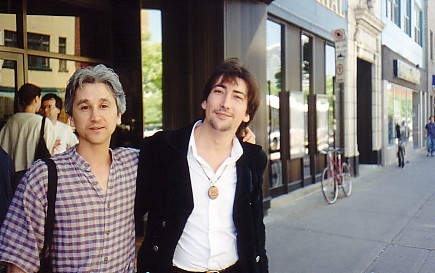
Author with Stanley outside Imperial Theatre (photo source, Donato Totaro)

Offscreen: That’s interesting because all of the classic movie monsters right up until the thirties, the wolfman, the mummy, King Kong, Dracula, Mr. Hyde, all these monsters were sympathetic.

Richard: Yes, essentially tragic heroes.

Offscreen: And then at some point, the sixties onwards, cynicism kicked in.

Richard: Yes it changed quite a bit, yet that element still persists, of sympathizing with the creature.

Offscreen: There’s a bit of that in your Dust Devil character.

Richard: Yes there’s one difference again between my cut and the Miramax cut, and that is you don’t get to see him cry in the Miramax cut.

Offscreen: That’s the bed scene between Wendy and the devil.

Richard: Yes, they removed his one weak moment where he gets to cry. It’s cut from the American print.

Offscreen: I wanted to ask you about that scene because it seems to pull together a lot of different things. For one you have the circular boom shot that comes down from the ceiling toward them…

Richard: Yes, that’s another attempt to make a spiral motion in the movie.

Offscreen: And the shot right before it is of the concentric primitive wall painting.

Richard: Yes, the film is constantly trying to spiral, which is why the plot construction is so messy. It has this silly spiraling plot construction where all the plot threads, and characters are looping around each other but don’t really get to meet until the tail end of the movie. There are three or four different running strings of events going around each other and actually zeroing in on an ending, and then his head explodes!

Offscreen: But the end has a circularity with Wendy perhaps taking over as the new host body for the dust devil.

Richard: I sort of attempted to construct it as a spiral. It’s not a Hollywood structure at all.

Offscreen: Why the zebra blankets?

Richard: Oh, the zebra was pure African tack, like the radio commercial about some safari. It’s what you’d sort of expect from Africa. The tacky hotel with pictures of rock formations and the zebra skinned bed were just your classic tacky African safari-oriented motel decor. I thought I’d keep it constant as fairly recognizably African or South African.

Offscreen: I love that shot toward the end of the film inside the abandoned building when the camera makes a semi-circular track from Wendy, to a mirror in which we see the Dust Devil reflected outside the window and finally to Ben hiding up against the wall. It reminds me of a similar shot at the end of Deep Red.

Richard: That’s one of my favorite shots in the film. I don’t really know what it means or how it fits into the rest of the film. It came at a time during a halt in the production and I thought, well I’m going to take as much time as necessary to get this complicated shot, and it took a whole day to get it down.

Offscreen: I’ve been thinking a lot lately and I think it relates nicely to your work because of how you tend to mix genres, of this idea of a new genre, the art-horror film. European and American films like The AddictionNadjaDellamorte Dellamore which mix elements of the horror genre with the art film. What do you think about this confluence of art and horror?

Richard: Well, I have a complicated take on that, which is the non-generic, complicated explanation to horror. The easy one is, that my formative influences are King Kong and Dracula, and that’s easy to understand. Then there’s the hard one to understand, which in a nutshell goes like this. For thousands of years true art was considered to be things that dealt with spirit, with God, the devil, the devil’s soul, and the afterlife. Art was something that was sponsored by churches, like the ceiling of the sistine chapel, great art was considered to be religious art. It seems to me that only in the 20th century has this dichotomy developed where essentially we’ve managed to separate religion from art completely, where art now seems to be based more on social realism and social commentary. Where regularly we give out the Turner prize to people who take out plastic casts of the inside of their terrace houses or make comments about their personal space or about society. The great art or fine art recognized by the people who put out the prizes and by the galleries, is nearly always obsessed with society, social conditions and the space we are living in, literally the physical, material space we’re in. The issue of spirit, soul, eternity, is completely missing, in all respects. If you deal in a film with God, the Devil, the afterlife, inevitably you’re in the genre, where films that deal with these subjects end up being films like Jacob’s LadderBrainstormFlatlinerGhostThe Exorcist. The moment you start dealing with God, the Devil, the big issues, you end up in the genre, whether you like it or not. So in some bizarre way the horror genre has become the last place where you can really deal with these things. If you’re trying to actually do something which is about those kinds of issues, that is where you end up. Even Tarkovsky ended up in the genre, whether he knew it or not, with Stalker and Solaris which are science fiction. So even Tarkovsky was drifting into the genre simply through his interest in these areas. If you’re trying to deal with those kind of issues there’s almost nowhere else to go because they won’t allow it in a conventional movie. You can’t have a supernatural thing happening in an otherwise ordinary movie without people saying, hey you can’t do that. You can’t all of a sudden have someone move a glass on the table with their mind in an ordinary movie [ed. Richard Stanley is here referring to a scene in Stalker ]. If that happens it’s got to be genre. So therefore in the 20th century for some reason all what I consider to be all the big issues have somehow been sidelined into a ghetto genre. But this is actually 100% in keeping with the underground stream and the way the stuff is meant to survive. Because traditionally, esoterica is meant to survive inside gothic art as a self-censoring secret, as something which survives symbolically, which is available for those who care. So apparently the idea of a mystical tradition or a tradition of dealing with spiritual issues, surviving encoded in a debased ghettoized genre, survives in something the public at large would regard as one step above porno, roughly the same level as comic books. Something which is looked down upon from a dizzy height as compared to the perceived serious movies, the Ghandi ‘s and The English Patient ‘s of the world.

Offscreen: So art and horror inevitably gravitate toward each other.

Richard: Yes, because ultimately, it’s the only way you could deal with God. It’s a funny way if one is actually concerned with it. And I’m very concerned with it because I know I’ll die one day and it is of extreme importance. I also recognize the genre will always be with us because I know that inside of every person there is that same knowledge that everyone knows they are going to die. All of us quietly wonder about it, what it will be like. In the simplest meaning people watch horror because they are frightened of the bad death, and they are interested in knowing what it would be like. When you’re a teenager you want to know about sex and death, so you sneak onto a horror movie. You don’t really know why but you’re inquisitive because these are things you need to know about since they will happen to you.

Offscreen: The horror genre is also very much about transformation, a metaphorical reflection on different stages in one’s life, both physiological, like sexuality, and psychological.

Richard: They speak of truth, which is often unavailable in any other form. One thing I’ve really noticed in life which is increasingly true to me is that one is inevitably confronted with horror in some way. Life messes you up. It kills the people you care about, rapes one’s loved one’s, destroys the things you care about, anything you love gets ultimately killed. If you have a pet it gets killed, or it dies horribly. At the same time the only sort of relief you get is a relentless constant stream of American products which are constantly telling us it will be fine, it’s all good, we’ll all live forever, we’ll all be happy, it will all work out. Beyond a certain level this can’t speak to us in the same way that a horror movie will speak to us, which is, yes things can be terrible, but maybe within that there is something which is not totally hopeless.

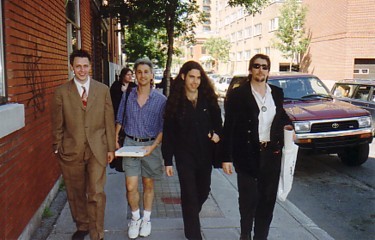
Prowling the streets of Montreal ‘Reservoir Dogs’ style, L-R, James Gunn, Author (holding pizza box!), Mitch Davis, Richard Stanley (photo source, Donato Totaro)

Prowling the streets of Montreal ‘Reservoir Dogs’ style, L-R, James Gunn, Author (holding pizza box!), Mitch Davis, Richard Stanley

Offscreen: Along that line, there is the scene in Dust Devil where Wendy first picks up the devil. They are driving along and he asks her whether she believes in God, the devil, the spirit, the soul, and she says no…

Richard: Like in Peter Pan, she is called Wendy on purpose… there’s a lot of Peter Pan jokes in that movie!

Offscreen: She specifically says I don’t believe in magic, and then at that point we cut to the devil outside the car hitchhiking along the road, yet she still doesn’t believe what she just saw, doesn’t believe her eyes, the physical world. Is that a comment on non-believers who even if they see magic don’t believe it?

Richard: Yes I guess so, but I’m not really sure what that scene means. I put that scene in the movie because I felt somebody in some movie had to do that scene, because that scene’s been happening again and again and again in the 20th century. The disappearing hitchhiker story has been reported million’s of times, so I felt someday someone in a movie has to actually do that scene where you’re talking with the hitchhiker and you look around and he’s disappeared from the passenger seat. I have no idea what that means, or why it happens to people but it does seem to be a surprisingly common experience. People all over the world seem to have vanishing hitchhiker situations or a bunch of hitchhiker stories. We’ve seen it happen in Africa, in Australia, in Britain, in America, all over the place people constantly report disappearing hitchhikers. Usually they’ll say something ominous or make out prophecies. It’s not my story, neither do I know what it entirely means or why it is that we at least feel compelled to report the incidents, regardless of whether they actually happened or not. I wanted to include it in the movie to root it to some actual pop mythology. Just as the walking man, the man with no name is not my creation but is an attempt to put a recognizable pop mythology icon in there and explore that a little.

Offscreen: It also can be very mystical.

Richard: Yes, I by no means take credit for him. I just wanted to set the record straight because Eastwood is doing a poor job lately by misinterpreting the man with no name by making him more human or more on the side of the angels than he was. He seems to have drifted apart from the spaghetti westerns. As he’s gets older he wants to be more human and has tried to make the walking man a nicer person, and in the end denying the more frightening aspects of that character. I thought the television version of The Stand was appalling, awful. Basically it was a recent attempt to deal with the walking man with no name archetype, and I felt it was poor on that level.

Offscreen: And it’s treatment of morality, good and evil, was so trite and simplistic.

Richard: I was so disappointed by their devil. I thought that’s just not the walking man. In a funny way, Val Kilmer would play the walking man very well, yet it doesn’t need to be sexy, it can’t be Jamie Sheridan. I just figured at the time when I made Dust Devil it was like a Tarot card in which the traveling man with his worn down boot heels somewhere between towns, walking the miles somewhere out there had to be defined. I felt he deserved a screen incarnation or to be somehow crystallized into something. I wanted to try and capture him and define him a little. But I’m never sure who he is or what he means because I didn’t invent him. I myself express a certain amount confusion over what his precise symbolic value is.

Offscreen: It seems to borrow a lot from the Orpheus myth. He comes from the other side of the mirror to collect the soul’s of people who are dying and bring them back.

Richard: A lot like that, and it also works as a kind of demon lover from an Id movie, because we are never sure whether he’s there or not, like when he pops in and out of the car seat talking to her when she’s run away from her husband. Imagine that you’ve just run out on your husband and your diving across the desert and all of a sudden Clint Eastwood materializes in your passenger seat and he’s asking you how your doing. Then he’s gone and later he pops up in your motel room, then he’s gone again. I keep wondering if he was ever really there. I think the film would double bill quite well with Andrzej Zulawski’s Possession, which is another marital breakup movie where the angst is manifested into a non-existent tentacled creature, which is sort of a coalescence of everyone’s pain. I thought that in a way he’s almost an invisible character who coalescences out of all the collective pain of the movie.

Offscreen: The Brood is another one of those type of marital breakup angst films…Cronenberg made it after a messy breakup and referred to it as his Kramer vs. Kramer.

Richard: That was the sense of things that I had, like a topic extrusion of the whole thing. Like you said earlier, he comes from the other side of the mirror and as he says at one point, “I come from you” which is fairly specific.

Offscreen: Yes I love the dialogue like that which runs throughout the film.

Richard: It’s a little portentous and at times I’m aware of how young I was when I made it…on the earnest kind of adolescent level at times.

Offscreen: I especially love the line where the devil says, “There is no good or evil, only spirit and matter.” Coming at a time when most screen monsters grumbled or spouted comical one-liners, it was quite refreshing.

Richard: I’m glad I put that line in. A lot of the time he’s speaking pure gnosticism. There are whole junks of it were’s he just coming out with pure gnostic heresy. I don’t think it was even intentional, but it strikes me now when I watch the movie and see how he goes on about good and evil, spirit and matter, light and dark. It basically dispenses with conventional morality and tries to replace it with a totally different idea of movement toward the spirit or away from the spirit. The friction between matter and spirit, rather than good or evil is definitely outlining something similar to gnostic thought, although I wasn’t that aware of gnosticism when I made the movie. It was only afterwards that I thought, wow, I sort of understand where he was coming from.

Offscreen: Relating to that duality between spirit and matter, as I said before, the film plays around with circular imagery a lot, thematically and visually. Like the moment where Wendy wants to get to the edge, the end and drives to the precipice. To me that represents a linear conception of the world, going straight and ending somewhere. That’s her moment, so it’s as if she represents the white man and the linear, Christian conception of temporality or the afterlife, as opposed to the circular conception’s of time associated with many Eastern, native or aboriginal cultures. Is the South African conception of time similar to that of the aboriginal dream time?

Richard: Yes, quite similar, but let’s not be too specific about the Bushman and the way they are in the movie because I wanted to make the mythology a little bit more universal. I tried to imply this by having the resident keeper of wisdom in the movie, the witch doctor/drive-in projectionist character as a little untrustworthy. As Ben says, you’ve been watching too many drive-in movies. Maybe he is coming from an ancient tradition but it’s also because he’s wearing a walkman and working at a drive-in, that the witch doctor’s quite likely to be very sophisticated and is probably drawing on all kinds of different things. For example we know there’s a vampire film playing…

Offscreen: Yes, and he does function somewhat like a Van Helsing character.

Richard: Yes, that’s right, so I have a certain amount of mistrust in the witch doctor because he’s obviously not in the stone age, he’s living in the 20th century. And the killer of course is not from Africa, he’s from elsewhere. I tried to imply this somewhat by having some ruins in the brief shots of the coins he’s left on the table that are bits and pieces from different cultures to give the sense that the guy’s been around all over the place. I know he would be right at home. I always thought, where would I be if I were the devil? I’d be in Beirut, in Yugoslavia, all the places where the walking man would come to call. Not just Namibia, but no doubt wherever things like that were happening and no one would notice him. This way rather than being specific about the Bushman, one could actually open it up to a lot of people. I do believe that at their source, most cultures are very similar and that we all have similar conceits. Like the center of the universe, the one tree, and the Hopi Indian idea of the ancestral point of emergence and the journey down into the underworld…this ceaseless spiraling into infinity.

Offscreen: How about dreams, how important are they to you as a source of artistic inspiration?

Richard: Very important…I don’t have enough of them anymore. I do dream, but I don’t have the right kind of dreams as much as I want to have these days. It has to do with living amongst humans too much. As a result I tend to get dreams made up of frantic bits of social and relationship problems, work things which get recycled into one’s sleep. My dreams have become too mundane lately from living in London and in the West [huge laugh on my part]…really that’s what it is. I’m sure if I was out in the mountains or the woods for a while I would start to have stronger dreams again, but certainly I had very bad dreams about the walking man for years and years.

Offscreen: So you got some of your movie imagery from your dreams?

Richard: Yes, funny enough even more so in Hardware. The first three or four minutes of Hardware is based on my dreams, one of the same cycle of dreams. I dreamt for a long time about the walking man, and in that particular dream he’s walking around in hat and coat in the wasteland, searching for something, but I don’t know what. Then right in the middle of the dream he starts digging into the sand and suddenly digs up this metal skull, with camera lens eyes. I don’t know what happened after that, but the first few minutes of Hardware were definitely a dream. And there were many other dreams from that same period about the same guy in the hat and coat and that lapsed over into Dust Devil. I think he was a symbol of some sort of fear, of some sort of encroaching anarchy, chaos to an extent. A favorite dream moment I never ended up using was one where many things had happened, but in essence my house is on fire. All my things have burned up and I’m blown out through a window and lay dying in the garden, peppered with shrapnel. I look up and the walking man is dancing on the roof of my burning house, yelling “I’m dancing on the roof and there’s nothing you can do about it!”

Offscreen: For the opening of Hardware, had you seen or were you at all influenced by The State of Things by Wim Wenders?

Richard: Yes, I love that movie! I love Paris, Texas more over the years. I’ve been increasingly discovering I have insomnia and sort of feeling the need to stay up all night, singing Mexican songs and polishing shoes.

Offscreen: Wings of Desire is a nice one as well.

Richard: Yes, it’s his last good one. I just think something terrible happened to him after that, I don’t understand it. Until the End of the World and all the other one’s seem totally awful, I hated it, and Far Away So Close as well. Everything Wenders says these days I don’t understand, when he talks in interviews he seems to be coming from another planet. He even renounced his early movies. I don’t know what happened. He says he wouldn’t make them like that anymore and finds them too slow to watch these days. I used to admire him like mad, now he’s gone so wrong these days it almost makes me want to reexamine his early films and not like that so much.

Offscreen: It’s almost as if you have to think of them as two different directors, Wim Wenders 1 and Wim Wenders 2.

Richard: Yes, it’s terrifying when that happens to people. I’d hate it to happen to me, because you obviously don’t notice when it happens, when you stop making good work and go off the boil. It’s happened to Dario [Argento] and I love Dario, but it’s happened to him for sure, and he won’t come back either.

Offscreen: You don’t think so…you’re down on Stendhal Syndrome all the way?

Richard Stanley with Mariano Baino, Patrizia, & Sergio Stivaletti (photo source, Donato Totaro)

Richard: Yep, I’m afraid so, it’s awful, so is Trauma. Very unfortunate. It shows little sign of any hope really.

Offscreen: All this reminds me somewhat of Lev Tolstoi, and his great tranformation in art after he converted to Christianity, wrote What is Art? and denounced all his earlier great works in favor of his later works which where lesser works of art but contained more direct moral messages. I think someone like Andrei Tarkovsky got it right with his balance between great art and morality.

Richard: I think Tarkovsky was also losing it toward the end, I hate to say that, but I don’t like The Sacrifice much, you know, it’s his least work. It’s a good film by anyone else’s standards, but it’s a strange progression from Nostalghia because in Nostalghia the character burns himself and in the next movie he burns his house, and it struck me as a kind of anti-climax. If he would have shot them in the opposite order it might have been different, but it struck me that by the time he got to The Sacrifice he wasn’t saying anything new and at the same time saying it with less power than he did before, which was a bad sign. Even Nostalghia I didn’t like quite as much as Stalker and Mirror, which are amazing works. But, of course, on days when I don’t think Stalker is the greatest movie ever, it’s Mirror. I wish Tarkovsky had made Bulgakov’s The Master and Margarita, I’d love to have seen what he would have made out of a devil movie. But I was disappointed when I saw The Sacrifice

Offscreen: I still like it very much

Richard: I still like it, by anyone else’s standards it’s great. It’s the same as what’s happened to Werner Herzog, he’s also completely lost it, in that Scream of Stone and Cobra Verde, are very disappointing compared to the earlier works. But at the same time, Cobra Verde by any other filmmaker is still a good movie. One can’t complain too much. Dario is sort of the same, I mean Stendhal Syndrome while bad is ultimately better than the average American horror movie. Which is being extra hard on these people but it’s because they’re really capable, and it sort of is sad to see them at anything less than full power.

Offscreen: We’re doing this for their own good!

Richard: It is rather. Dario I always want to somehow jolt him or blast him, or write some material for him, or do something, I can’t believe he’s lost it for good, it’s too depressing, and Opera ‘s such a short time ago, it seems like a very rapid decline.

Offscreen: I was thinking of Tarkovsky, and relating him to your work, I could see quite a bit, snippets of him, especially in Dust Devil , like in the scene where the devil visits the boy at the military shooting range, which is right out of Mirror.

Richard: It’s interesting that you should say that.

Offscreen: I may be the only person who noticed that!

Richard: Because of course it’s also one of the scene’s in the movie which is most true to life for me, but obviously Mirror touches me deeply, possibly Mirror touches me deeply because there are elements in it that are very similar to bits of life which one recognizes, and that scene is very much based on an incident which happened to me when I was that boy’s age.

Offscreen: There are many other instances of Tarkovsky emerging in your films, like the naming of the “Zone” in Hardware, the scene of the burning house and encircling car, and the incongruous telephone ringing in the abandoned house in Dust Devil . I was intrigued when I read in your Dust Devil diaries that you kept a copy of Tarkovsky’s book Sculpting in Time on the set with you to consult in times of duress. In what way do you find inspiration from Tarkovsky?

Richard: Well, Andrei really is for me like a patron saint, a guiding light in the midst of chaos. When everyone else is running around losing their heads, freaking out about the pressures of time, saint Andrei speaks to me in a still voice and gives me an idea of what really matters, of what it was that we really got involved in this medium for in the first place. His films demonstrate the potential for this medium to reach people, to touch people’s souls and hearts and to somehow communicate something of the essence of what it is like to try and be alive in this world. I know this is extremely woolly, and Tarkovsky himself would have had a very hard time explaining his own work, but a great number of things the man did and labored towards are inspirational. In some respects even the essential ambiguity of his work and the way he labors toward the situation of maximum ambiguity as opposed to the way an American would work and the way people insist that everything should be nailed down to just one meaning and one definition.

Offscreen: Nice. I guess I could use this idea of maximum ambiguity as a lead in to the final shot of Dust Devil, which you’ve jokingly referred to as your Tiannamen Square shot. Could you talk a bit about this final ambiguous, almost mythical image?

Richard: As scripted at the end of the film, the main character having survived various tribulations in the plot is meant to find a way out of the desert to the nearest road and be rescued. But once we came to shoot the scene of course this seemed rather simplistic; and as we had at our disposal a convoy of armoured cars lent to us by the Namibian defense force I started to imagine the traffic on the road as representing the future. The road itself seemed to represent a linear time line moving through the spiraling chaos of the film. The plot structure is very much a spiral and the road is kind of a straight line right through that, but nonetheless, I had chosen in the end to portray the vehicles in the road in such a threatening manner that they scarcely seemed to be rescuing her, just as the red light up ahead scarcely promises salvation but promises something quite frightening further down the line. At the same time we’re not even sure anymore whether she’s the heroine or whether she’s the devil incarnate. I’m not sure whether she’s going to be rescued by them or whether she’s going to kill them, or whether they are going to kill her. I went to some lengths to cut out of the scene before the vehicles even started to slow down because I didn’t want to resolve it one way or another. I wanted to leave it hanging on the edge as much as possible so the audience could make up their own mind as to whether she was a heroine or bad guy, whether she was being rescued or going to be killed, or what was going to happen next. I wanted to leave it more or less so anyone could take home from the movie whatever it was they wanted to feel. Which is something that saint Andrei was very, very good at, in that every single time that I see Mirror it seems to mean something entirely different to me, full of varying different messages and no one of them seems to be the actual explanation. I think in that way I attempted to produce a situation of maximum ambiguity. I mean for me ultimately, magic is something that can’t be described. If I had in my hand an object which was indescribable, which could be any object, then presumably it could appear to be all things to all people. One person would think I were holding a cigarette, someone else would think it was a knife, someone else might think it’s a flower; but if someone had something which could be infinitely ambiguous, then you’d have something which is truly magic, which every single person could interpret in their own way, to have some personal meaning which was unique to them. I’m getting lost here, so I’ll stop!